

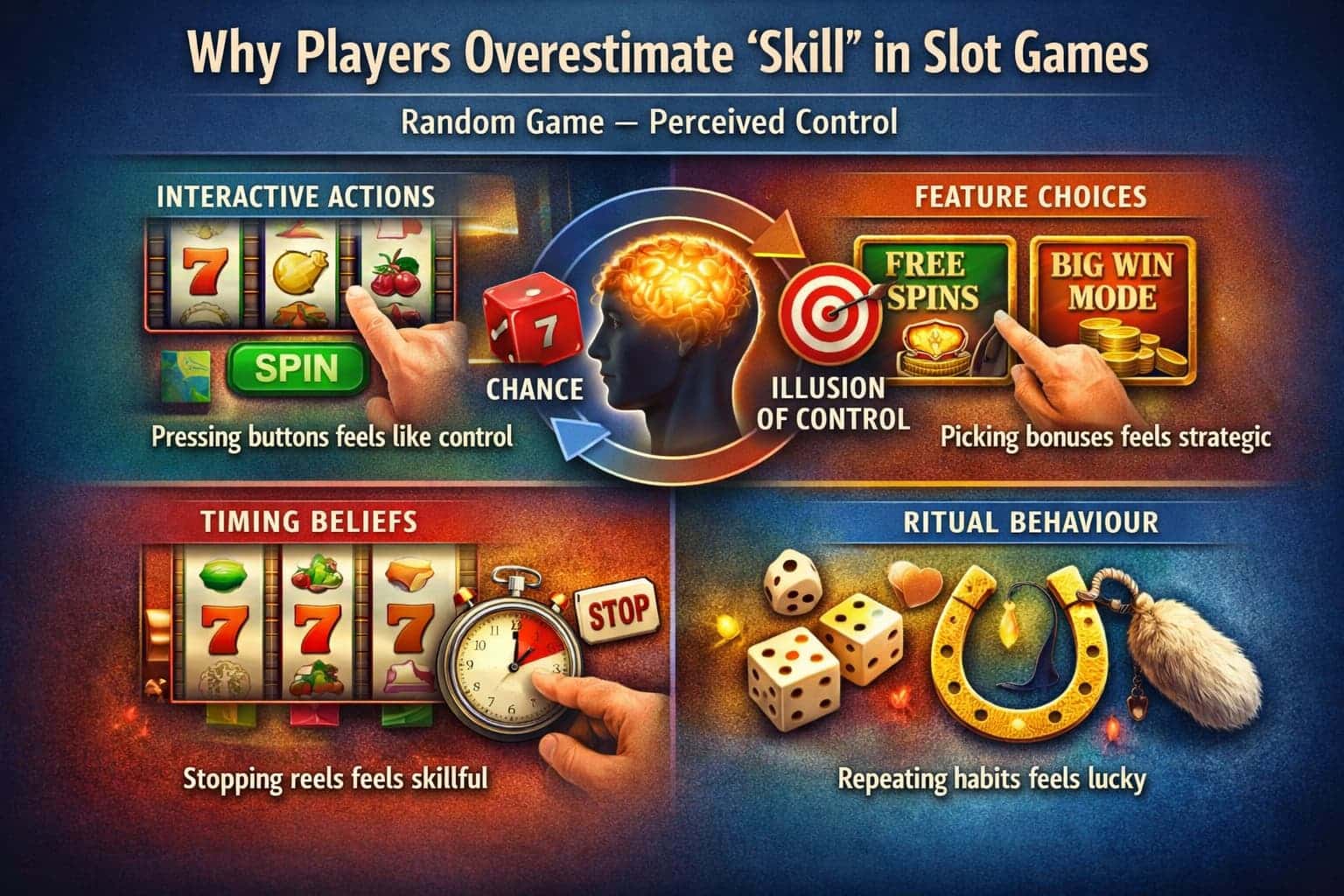
Slot games are obviously games of chance, yet many still believe they can influence outcomes with special techniques and strategy.
Some players talk about timing the spin, choosing the right feature, or playing a slot the “right way”. Even experienced players who know about RNGs and RTPs often feel that skill plays a role — at least sometimes.
It makes me think of a scene from The Mike Nolan show (any Big Lez fans here?) – where the animated main character Mike plays pokies down at his local RSL and shares a tidbit of pokie wisdom:
“It’s all a big mind game, what you gotta do – you gotta hit the spins roughly three and a half seconds between each and make sure to do five dollar bets…give the machine a tap on the side after every 5 spins and I guarantee in about 7 rolls you’ll get a feature.”
This is a classic fallacy, obviously taking the micky out of pokie players who feel like they know how to beat the system.
This doesn’t mean these players are naïve or a bit gullible. It’s the result of how human psychology interacts with interactive game design.
Slots ask players to make frequent decisions: when to spin, how much to bet, which feature to choose, whether to stop or continue. Each of these actions creates a sense of agency. When something good happens after a choice, the brain naturally links the two — even if the outcome was already determined.
Over time, this leads to an overestimation of personal influence. Players don’t usually believe they can beat slots consistently, but they do believe they can improve their chances, avoid bad runs, or play more “smartly” than others.
This article explores why that belief is so common.
We’ll break down the key psychological mechanisms that make slot games feel skill-based, including:
- The illusion of control created by interaction
- Myths around feature selection and timing
- Pattern recognition where none exists
- Design choices that reinforce perceived influence
- The hard reality of RNG-driven outcomes
Understanding these factors doesn’t ruin the enjoyment of slot play. In fact, it often does the opposite. Recognising where control ends and randomness begins allows players to engage with slots more consciously — without attributing wins and losses to skills that don’t actually exist.
The Illusion of Control in Slot Games
The illusion of control is a well-documented psychological effect where people believe they can influence outcomes that are actually random. Slot games are one of the clearest real-world examples of this phenomenon.
At their core, slots are governed by random number generators (RNGs). Outcomes are determined the moment you press spin — and in many modern systems, even before that. Despite this, the act of doing something creates the feeling that the result is connected to the action itself.
Why Interaction Creates False Control
Human brains are wired to associate action with consequence. When you press a button and something happens immediately afterwards, your mind naturally links the two, even if the connection is purely coincidental.
In slot games:
- You press spin
- Reels animate
- A result appears
This sequence strongly suggests causation, even when none exists.
Passive vs Interactive Chance
| Scenario | Level of Interaction | Perceived Control |
| Lottery ticket draw | None | Very low |
| Roulette spin | Low | Low |
| Slot machine spin | High | High |
Slots feel different because players are constantly interacting. Every spin reinforces the sense that personal input matters.
Near-Misses and Reinforced Belief
Near-miss outcomes play a major role in strengthening the illusion of control:
- Symbols stop just above or below a win
- Bonus triggers appear one symbol short
- Reels “almost” line up
These outcomes feel like progress — as if the player is getting closer by doing something right — even though each spin is independent.
Why Knowledge Doesn’t Eliminate the Illusion
Even players who understand RNGs aren’t immune. Knowing something is random doesn’t stop the emotional brain from reacting to perceived patterns.
You may know:
- Each spin is independent
- You can’t influence outcomes
But still feel:
- “That spin was mistimed”
- “I should’ve waited”
- “I nearly had it”
The illusion persists because it operates at an instinctive level, not a logical one.
Key Takeaway
Slot games feel skill-based because they are designed to be interactive. The more actions a player performs, the stronger the illusion of influence becomes. This isn’t manipulation in a sinister sense — it’s a natural outcome of combining random systems with responsive design.
Feature Selection Myths
Many modern slot games offer players meaningful-looking choices: selecting a bonus feature, choosing a game mode, or picking between different volatility settings. These options feel strategic, and players often believe that picking “correctly” improves their chances.
In reality, most of these choices do not influence the underlying odds in the way players assume.
Common Feature Selection Beliefs
Players often believe:
- Certain bonus features pay better
- Some modes trigger more often
- Picking manually beats random selection
- One option is “safer” than another
These beliefs feel logical, but they usually confuse presentation differences with mathematical differences.
What Feature Choices Usually Change
| Feature Choice | What Players Think Changes | What Actually Changes |
| Bonus type | Chance of big win | Win distribution style |
| Game mode | RTP | Volatility profile |
| Manual pick | Luck | Visual involvement |
| Feature order | Odds | Pacing only |
Most feature selections affect how wins are delivered, not whether they occur.
Volatility vs Advantage
Choosing between features often means choosing risk style, not advantage:
- One option may offer smaller, more frequent wins
- Another may offer rarer, larger payouts
Over time, the expected return is usually the same. The difference is emotional, not mathematical.
Why Choice Feels Powerful
Feature selection triggers several psychological responses:
- Ownership: “I chose this”
- Commitment: sticking with a decision
- Attribution: crediting wins to the choice
When a selected feature produces a good result, players remember the decision that preceded it.
The Illusion of “Better Picks”
Because big wins are memorable, players tend to:
- Recall successful feature choices
- Forget unsuccessful ones
- Assume a pattern exists
This selective memory reinforces the belief that skill or insight was involved.
Key Takeaway
Feature selection in slots creates engagement, not advantage. While different options may feel more or less rewarding, they rarely change the underlying odds. The sense of control comes from choice itself — not from improved probability.
Timing Myths: “Stopping the Reels at the Right Moment.”
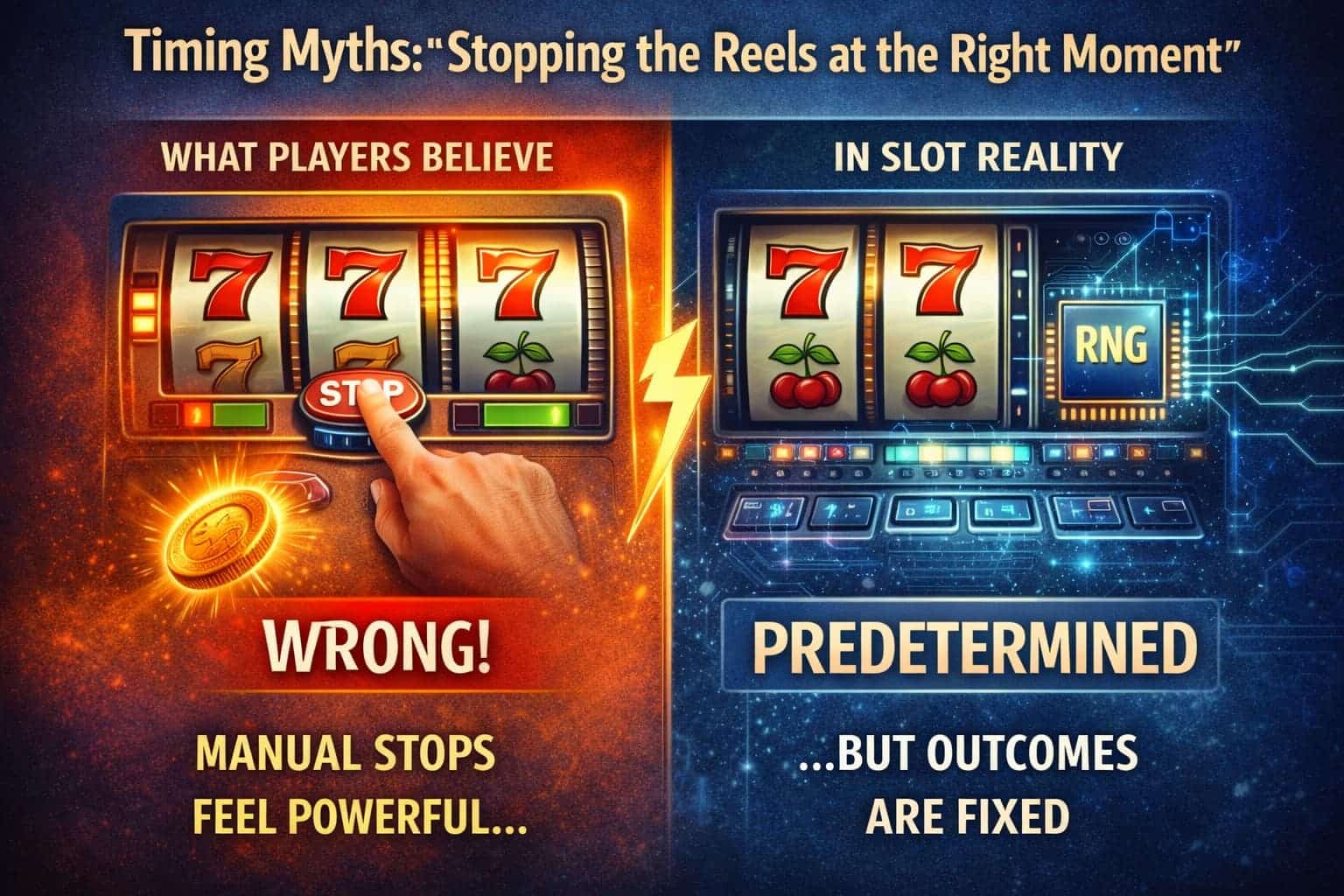
One of the most persistent beliefs in slot play is that timing matters — that pressing spin at the right moment, stopping the reels manually, or waiting between spins can influence results.
These beliefs feel intuitive. After all, timing matters in many real-world activities. In slot games, however, timing is one of the clearest examples of perceived control without real influence.
Common Timing-Based Beliefs
Players often believe:
- Quick spins reduce losses
- Delaying spins improves odds
- Manual reel stops affect outcomes
- Waiting after a win or loss changes results
Despite how convincing these ideas feel, they don’t align with how slot systems work.
What Actually Happens When You Spin
| Player Action | Perceived Effect | Reality |
| Press spin | Outcome is “in progress” | Outcome already determined |
| Stop reels | Alters symbol position | Visual only |
| Delay spin | “Resets” the game | No impact |
| Rapid spins | Changes timing | Independent events |
The result is generated by the RNG the moment the spin is initiated. Everything after that is animation.
Why Reel Stopping Feels Influential
Manual reel stops create a powerful illusion:
- You act mid-spin
- Reels visibly respond
- Symbols land immediately
This sequence suggests real-time control, even though the outcome was fixed before the reels started moving.
The Role of “Almost” Outcomes
When a stopped reel lands close to a win, it reinforces belief:
- “If I’d waited a second…”
- “I stopped it too early”
- “That was badly timed”
These thoughts ignore the fact that the visual stop has no relationship to the RNG result.
Why Timing Myths Persist
Timing myths survive because:
- Players remember near-wins vividly
- Losses without drama fade quickly
- Humans search for patterns in sequences
Random systems produce streaks naturally. Timing beliefs give those streaks a story.
Key Takeaway
In slot games, timing affects presentation, not probability. Manual stops, delays, and spin speed feel powerful because they involve direct action — but the outcome is already decided. The belief that timing matters is one of the strongest and most common illusions of skill in slots.
Button Patterns and Ritual Behaviour
Many slot players develop personal rituals. They spin in a certain rhythm, press buttons in a specific order, or repeat behaviours they associate with past wins. Over time, these habits can feel like methods rather than routines.
This is another way players come to overestimate skill — by mistaking consistency of behaviour for control over outcomes.
Common Slot Rituals
Players often:
- Always press spin after a pause
- Change bet sizes in a set sequence
- Switch games after a loss
- Repeat actions that preceded a big win
These actions feel purposeful, even though they have no influence on the RNG.
Why Rituals Feel Effective
| Behaviour | Psychological Effect | Reality |
| Repetition | Creates familiarity | No causal impact |
| Structure | Reduces uncertainty | Outcomes remain random |
| Association | Links action to result | Coincidence only |
| Control | Lowers anxiety | False confidence |
Rituals provide comfort and predictability in an unpredictable system.
Pattern Recognition at Work
Humans are extremely good at spotting patterns — even when none exist. In random sequences, streaks and clusters naturally appear, and the brain tries to explain them.
This leads to beliefs like:
- “This game is warming up”
- “Cold streaks mean a win is coming”
- “It pays after a dry run”
These interpretations feel rational but are statistically meaningless.
The Role of Memory Bias
Wins stand out emotionally. Losses blend together.
As a result:
- Successful rituals are remembered
- Unsuccessful ones are forgotten
- The belief in effectiveness strengthens
Over time, rituals evolve into perceived strategies.
Why Rituals Don’t Go Away
Even when players intellectually reject them, rituals persist because they:
- Make play feel structured
- Reduce stress during losses
- Provide a sense of participation
They’re less about winning and more about feeling involved.
Key Takeaway
Button patterns and rituals don’t change outcomes, but they change how players experience randomness. By turning chance into routine, players feel more in control — even when the results remain entirely unaffected.
Why Choice Feels Meaningful
Slot games constantly ask players to make choices. Even small decisions — like selecting a bet size or choosing a bonus symbol — can feel significant. The presence of choice alone is often enough to create the impression that skill is involved.
This happens because choice triggers agency, even when it doesn’t affect outcomes.
Types of Choices in Slot Games
| Choice Type | Example | Actual Impact |
| Cosmetic | Avatar, theme | None |
| Structural | Paylines, features | Presentation only |
| Pacing | Spin speed | Timing only |
| Financial | Bet size | Risk exposure, not odds |
Most choices change how the game feels, not how it pays.
Ownership and Responsibility
Making a choice creates a sense of ownership:
- Wins feel earned
- Losses feel explainable
- Outcomes feel connected to decisions
When something good happens, the brain credits the choice. When something bad happens, it looks for a way to improve next time.
Choice vs Control
Choice doesn’t equal control — but it feels like it should.
| Concept | Meaning |
| Choice | Ability to select options |
| Control | Ability to influence outcomes |
| Skill | Ability to improve results |
Slots offer choice but not control, yet players often conflate the two.
Why Random Selection Feels Worse
When the game selects something automatically:
- Wins feel less personal
- Losses feel more frustrating
Letting players choose creates emotional investment, even if the result would have been the same.
Decision Fatigue and Confidence
Repeated choice can also inflate confidence:
- Familiar decisions feel “right”
- Confidence grows without evidence
- Players trust instinct over maths
This reinforces the belief that experience equals skill.
Key Takeaway
Choice makes slot games feel interactive and meaningful, even when it doesn’t change outcomes. By giving players agency without influence, slots create a powerful illusion of skill that feels intuitive — and hard to shake.
The Reality of RNG and Slot Maths
To understand why “skill” doesn’t meaningfully exist in slot games, it helps to be clear about where player influence ends and where randomness begins. That boundary is defined by the random number generator, or RNG.
Slots don’t adapt to players, learn from behaviour, or respond to timing, patterns, or decisions. They operate on fixed mathematical rules that run independently of how — or how often — someone plays.
What an RNG Actually Does
An RNG is a program that continuously generates random numbers, even when no one is playing. When a player presses spin, the game simply takes the next available result and translates it into symbols on the reels.
Key points:
- The RNG runs constantly
- Results are not “in progress” during spins
- The outcome is determined instantly
- Animations are purely visual
Where Player Input Stops
| Player Action | Affects Outcome? | Explanation |
| Pressing spin | ❌ | Triggers result, doesn’t shape it |
| Stopping reels | ❌ | Visual only |
| Changing timing | ❌ | No impact on RNG |
| Choosing features | ❌ | Alters presentation, not odds |
| Adjusting bet size | ❌ | Changes stake size, not probability |
*Bet size changes potential win/loss amounts, not the chance of winning.
RTP and Long-Term Expectation
Return to Player (RTP) is often misunderstood as a guarantee. In reality, it’s a long-term average calculated over millions of spins.
This means:
- Short sessions can deviate wildly
- Skill cannot “unlock” RTP
- Good or bad runs are expected
A player cannot influence when or how RTP expresses itself.
Volatility Is Not Skill
Volatility describes how wins are distributed:
- Low volatility: frequent small wins
- High volatility: rare, larger wins
Choosing a volatility profile changes emotional experience, not expected value.
Why Experience Doesn’t Equal Advantage
Experience helps players:
- Understand game mechanics
- Manage budgets
- Recognise myths
But it does not improve odds. A new player and a veteran player face the same probabilities on every spin.
Key Takeaway
Slot maths are fixed, impersonal, and indifferent to player behaviour. RNGs don’t reward skill, punish mistakes, or respond to patterns. Understanding this doesn’t remove enjoyment — it simply clarifies where control ends and chance takes over.
Casino and Game Design Psychology
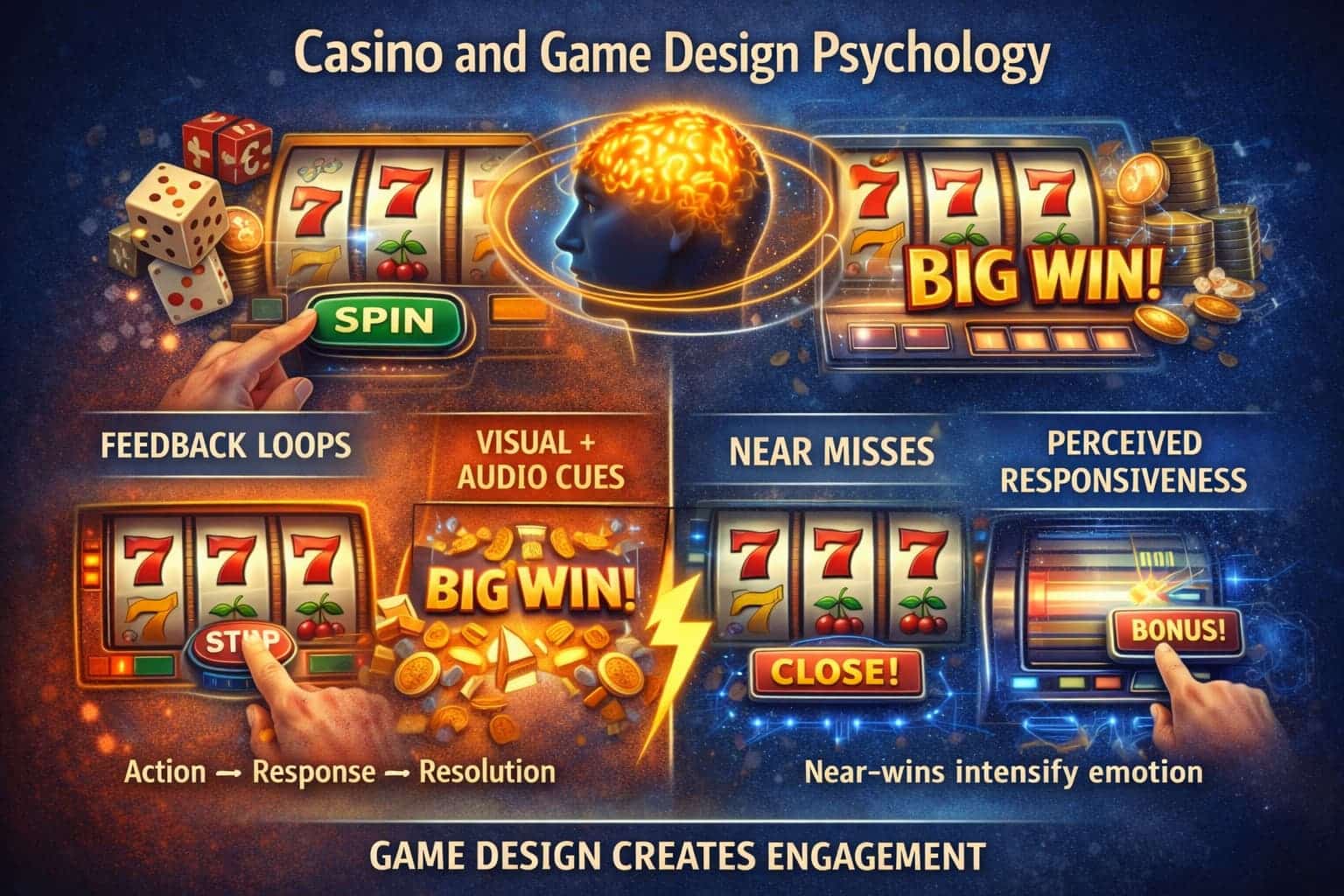
While slot outcomes are random, the experience of playing them at online casinos is carefully designed. Game developers use well-established psychological principles to make slot play engaging, intuitive, and emotionally responsive — without altering the underlying odds.
These design choices don’t create unfairness, but they do shape how players interpret outcomes.
Feedback Loops and Reinforcement
Slots are built around rapid feedback:
- Action (spin)
- Response (animation + sound)
- Resolution (win or loss)
This loop reinforces the connection between player input and outcome, even when that connection is illusory.
Visual and Audio Cues
| Design Element | Psychological Effect |
| Reel animations | Build anticipation |
| Win sounds | Amplify reward |
| Near-miss visuals | Encourage continuation |
| Celebration delays | Increase emotional impact |
The brain reacts to these cues regardless of logical understanding.
Near-Misses as Motivation
Near-miss outcomes are particularly powerful:
- They feel like progress
- They imply improvement
- They suggest the player is “close”
From a design standpoint, near-misses increase engagement — not because they change odds, but because they intensify emotional response.
Perceived Responsiveness
Games are tuned to feel responsive:
- Immediate button feedback
- Fast animation transitions
- Minimal input delay
This responsiveness strengthens the illusion that player actions matter.
Information Presentation
Design also influences perception through:
- Hidden probabilities
- Emphasised wins
- De-emphasised losses
Players see and hear wins more clearly than losses, which skews memory and reinforces confidence.
Design vs Deception
It’s important to distinguish:
- Design: Making a game engaging
- Deception: Misrepresenting odds
Modern regulated slots use psychological design without altering mathematical fairness.
Key Takeaway
Slot games don’t need skill to feel skill-based. Through sound, visuals, feedback, and pacing, design psychology creates a powerful sense of involvement — even when outcomes remain entirely random.
Recognising False Control as a Player
Understanding why slot games feel skill-based isn’t about taking the fun out of play. It’s about recognising when perceived control is psychological rather than real — and adjusting expectations accordingly.
Most players don’t need to abandon habits or rituals entirely. They just need to understand what those behaviours actually do.
Signs You’re Attributing Outcomes to Skill
You may be overestimating control if you find yourself thinking:
- “I should’ve waited before spinning”
- “That feature was the wrong choice”
- “This game pays after a dry run”
- “I was playing badly earlier”
These thoughts assign causation to actions that don’t affect results.
Behaviour That Feels Strategic (But Isn’t)
| Behaviour | Why It Feels Smart | What It Actually Does |
| Changing timing | Adds intention | No effect |
| Switching games | Feels corrective | Resets presentation only |
| Repeating rituals | Creates confidence | Reduces anxiety |
| Avoiding “cold” slots | Feels logical | Ignores independence |
Recognising this gap helps players stay grounded.
What Is Within Player Control
While outcomes aren’t controllable, some things are:
- Session length
- Budget limits
- Game selection based on volatility
- Break frequency
These decisions don’t improve odds, but they do improve experience.
Reframing Play in a Healthier Way
Instead of asking:
- “How do I play this better?”
It’s often more useful to ask:
- “How does this game actually work?”
- “What am I responding to emotionally?”
This shift reduces frustration and misplaced confidence.
Understanding Without Losing Enjoyment
Many players enjoy slots because they feel interactive. Acknowledging false control doesn’t remove that enjoyment — it simply prevents disappointment when intuition fails.
The goal isn’t to become detached, but to stay informed.
Final Takeaway
Slot games are designed to feel responsive, engaging, and skill-adjacent — even when outcomes are purely random. By recognising where control is illusory and where it’s real, players can approach slots with clearer expectations and a more balanced mindset.
Understanding false control doesn’t make slots less fun. It makes the experience more honest.
Frequently Asked Questions
Do slot games require any real skill?
No. Slot games do not require skill in the way strategy-based games do. While players make choices — such as bet size or feature selection — these decisions do not influence the outcome of spins. Results are determined by a random number generator (RNG), making slots games of chance rather than skill.
Can experienced players perform better on slots?
Experienced players may manage their sessions better, understand volatility, and avoid common myths, but they do not gain better odds. Experience can improve decision-making around money and time, not the likelihood of winning.
Does stopping the reels manually affect slot outcomes?
No. Manual reel stops are purely visual. The outcome of a spin is decided the moment the spin is initiated. Stopping the reels early does not change which symbols are selected by the RNG.
Are some slot features better than others?
Different features may offer different win styles — such as smaller frequent wins or larger rare payouts — but they usually have the same expected return. Feature choice affects volatility and presentation, not overall odds.
Why do slots feel more skill-based than they are?
Slots feel skill-based because they are interactive. Frequent decisions, animations, near-misses, and feedback loops create a strong illusion of control. Human brains naturally link actions to outcomes, even in random systems.
Is RTP affected by how or when you play?
No. RTP is a long-term statistical average calculated over millions of spins. It is not influenced by player behaviour, timing, session length, or device used.
Can changing slots after losses improve your chances?
No. Each spin is independent. Switching games may change how outcomes feel, but it does not reset odds or improve the likelihood of winning.