

When people talk about pokies, they usually focus on outcomes. Whether a game pays, how volatile it feels, or whether a session ends up ahead or behind. What tends to receive less attention is how the game feels while it’s being played — and that experience is almost entirely shaped by design.
Pokie game design isn’t about controlling results. Outcomes are governed by fixed mathematics and randomness that designers cannot influence once a game is built and certified. What design does control is attention, pacing, and emotional engagement. It determines what players notice, what they react to, and how long they’re inclined to stay involved.
This distinction matters, because many assumptions about pokie design blur the line between engagement and fairness. Players sometimes believe that visuals, sounds, or features are designed to manipulate odds or secretly influence outcomes. In reality, design operates around the maths, not through it. It shapes experience without altering probability.
Good pokie design makes randomness tolerable. It softens long losing stretches, highlights moments of excitement, and creates rhythm in an otherwise uneven process. Without these elements, the same mathematical game would feel flat, frustrating, or even unplayable over time.
At the same time, design choices aren’t neutral. Every sound, animation, and feature is intentional. Games are built to hold attention, encourage continuation, and create emotional peaks. Understanding this doesn’t require cynicism — it simply requires separating what design can influence from what it can’t.
This article explores what pokie game design is actually trying to do. We’ll look at how engagement is engineered without changing fairness, how reward loops and retention mechanics work, where regulation draws boundaries, and why player awareness matters more than suspicion.
The goal isn’t to expose tricks or undermine enjoyment. It’s to understand the role design plays in shaping experience — and where its influence ends.
Engagement vs Fairness
One of the most persistent misunderstandings about pokie game design is the idea that engagement and fairness are opposing forces. That if a game feels exciting, colourful, or immersive, it must be doing something unfair behind the scenes. In practice, these two things operate on completely different layers.
Fairness is mathematical. It’s defined by RTP, volatility, and the random number generator that determines outcomes. Once a game is certified, those elements are fixed. Designers cannot quietly adjust them through visuals, sounds, or features without breaching regulation.
Engagement, by contrast, is experiential. It’s about how the game holds attention while randomness plays out. A fair game can feel dull or frustrating if it presents outcomes bluntly. An engaging game can feel smooth and satisfying even when outcomes are unfavourable. The difference lies in presentation, not probability.
This is why two games with identical RTPs can feel completely different to play. One may feel tense and unrewarding, while the other feels lively and generous. The maths is doing the same thing in both cases; the design is shaping how that maths is experienced.
Designers focus on engagement because randomness is inherently uneven. Long losing stretches are normal, but they don’t feel normal to players. Engagement tools exist to make those stretches emotionally survivable without altering outcomes.
Engagement tends to influence things like:
- how often players feel something happened
- how clearly wins stand out from losses
- how smooth or jarring transitions feel
- how motivated players feel to continue
None of these change whether a player wins or loses. They change how tolerable the process feels.
Fairness also doesn’t mean emotional neutrality. A perfectly fair game can still be intense, exciting, or even frustrating. What fairness guarantees is that outcomes aren’t being manipulated. Engagement determines whether players want to stay present while those outcomes unfold.
Understanding this separation helps clear up a lot of confusion. Pokie design isn’t trying to make unfair games feel fair. It’s trying to make fair games feel playable. Once that distinction is clear, many design choices stop looking suspicious and start looking functional.
Visual and Audio Cues
Visual and audio cues are the most immediately noticeable parts of pokie design, and also the most misunderstood. Lights, animations, sound effects, and music don’t exist to influence outcomes. They exist to interpret them.
Online Pokies produce results that are often anticlimactic: a sequence of symbols that don’t line up, a balance that ticks down incrementally, a feature that doesn’t trigger. Without interpretation, most spins would feel flat and repetitive. Visual and audio cues provide emotional context to those results.
Wins are amplified through colour, motion, and sound. Animations slow down the moment, drawing attention to what just happened. Sounds rise in pitch or intensity, signalling that something meaningful occurred. These cues help players notice and remember wins more clearly than losses.
Losses, by contrast, are deliberately quiet. They resolve quickly, often with minimal sound or animation, allowing the experience to move on without dwelling on the outcome. This contrast isn’t about hiding losses — it’s about keeping the game flowing.
Designers use cues to guide attention toward specific moments, such as:
- a near-miss that visually slows down
- a feature trigger that unfolds in stages
- a win that builds gradually rather than appearing instantly
These cues don’t change the result. They change how the result lands emotionally.
Audio plays a particularly important role because it bypasses conscious analysis. Music tempo, pitch changes, and sound effects shape arousal levels and signal when players should feel alert, relaxed, or rewarded. This is why playing with sound off often makes games feel flatter and less engaging, even though nothing about the outcomes has changed.
Importantly, cues are regulated. Designers can’t use misleading signals that imply a win when none occurred. Sounds and visuals must correspond to actual outcomes, even if they make those outcomes feel more significant.
Visual and audio cues aren’t about persuasion in the sense of convincing players they’re winning more than they are. They’re about rhythm. They help create peaks and valleys in an otherwise uneven stream of results, making randomness easier to tolerate and more emotionally legible.
Once this is understood, these elements stop looking like manipulation and start looking like translation. The game isn’t trying to tell players what will happen next. It’s helping them understand what just happened — and how to feel about it.
Reward Loops
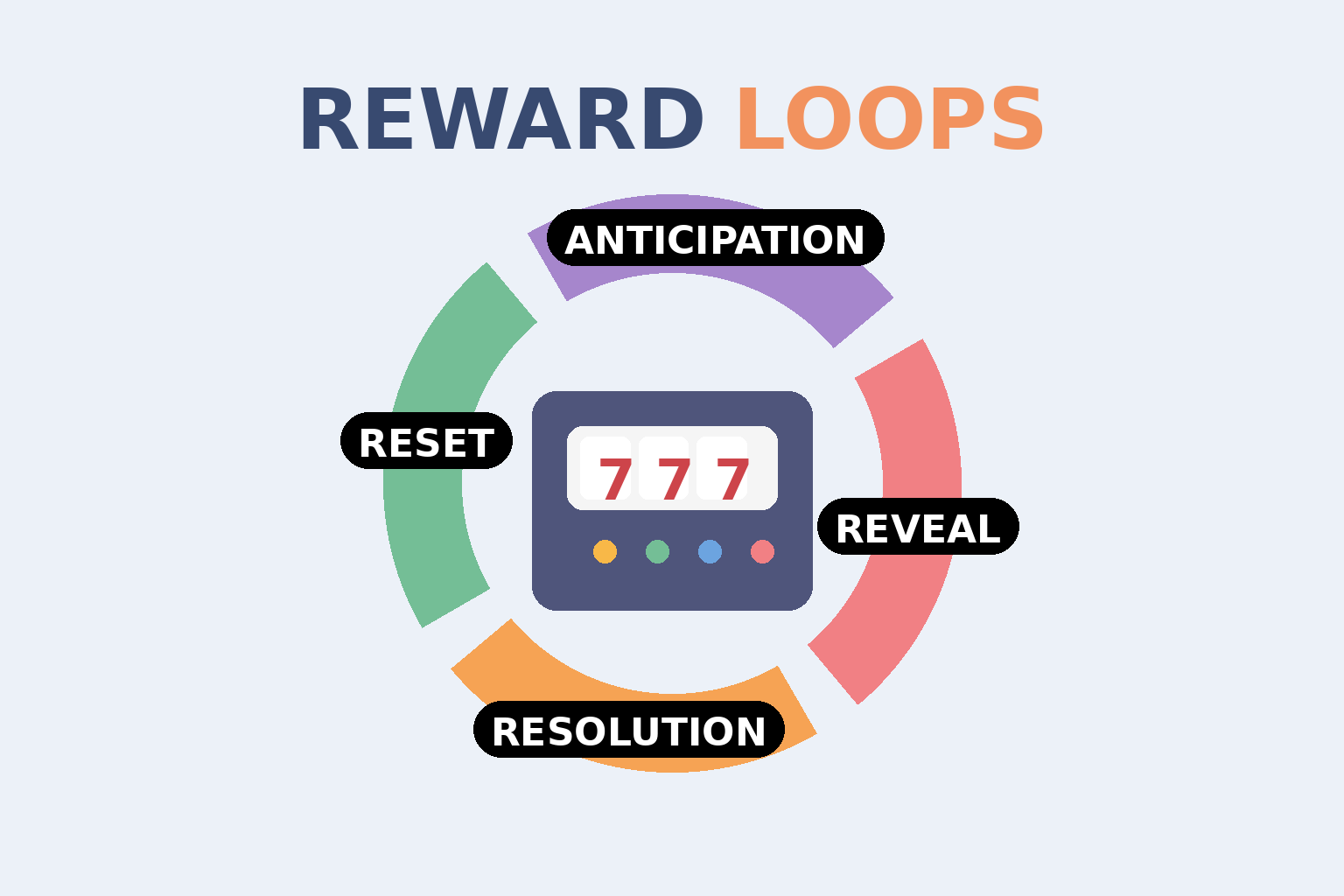
Reward loops are central to pokie design, but they’re often misunderstood as mechanisms that produce rewards. In reality, they organise how rewards are anticipated, revealed, and emotionally processed. The loop doesn’t change what the game gives — it shapes how players move through waiting, hoping, and resolution.
A typical reward loop begins long before a win appears. Symbols tease progress toward a feature. Animations hint that something is building. Sounds escalate as potential outcomes align. The player is drawn into a cycle of anticipation that resets with each spin.
What matters here is not the reward itself, but the cycle. The loop gives structure to randomness, making each spin feel like part of an unfolding process rather than an isolated event. This sense of continuity encourages engagement even when outcomes are unfavourable.
Reward loops generally follow a predictable emotional pattern:
- anticipation before the spin
- tension as symbols land
- resolution when the outcome is revealed
- reset as the next opportunity appears
This pattern repeats regardless of whether a win occurs.
The distinction between anticipation and outcome is crucial.
| Part of the loop | What design influences | What design cannot influence |
| Anticipation | Visual buildup, pacing | Probability of a win |
| Reveal | Timing, animation, sound | Size or likelihood of payout |
| Resolution | Emotional framing | Long-term expectation |
Because anticipation is repeated far more often than reward, players spend most of their time inside the loop rather than at its payoff. A well-designed loop makes that waiting phase tolerable, even engaging.
This is where confusion sometimes arises. When anticipation feels rewarding in itself, players may feel that something positive is happening even during losing stretches. The loop keeps attention focused forward rather than on accumulated losses.
Importantly, reward loops don’t guarantee satisfaction. They can’t override frustration indefinitely, and they can’t prevent losses from adding up. What they do is create rhythm — a sense that play is moving somewhere, even when outcomes are uneven.
Regulation ensures that reward loops cannot imply certainty or inevitability. Designers can suggest possibility, not promise. The loop must always resolve honestly, even if the journey toward that resolution is carefully choreographed.
Reward loops are not about deception. They’re about pacing. They organise uncertainty into something emotionally navigable, giving players a reason to stay present while randomness does what it does.
Retention Mechanics
Retention mechanics are often misunderstood as tools designed to keep players playing at all costs. In reality, they’re about reducing friction — smoothing the points where players are most likely to disengage. Pokie design isn’t trying to force continuation; it’s trying to prevent abrupt emotional drop-off.
Random outcomes naturally create stop-start experiences. A long losing run, a confusing feature, or a sudden balance drop can break immersion. Retention mechanics exist to soften those breaks and make continuation feel natural rather than jarring.
Common retention-focused design elements include:
- Clear progress indicators that show how close a feature might be
- Bonus structures that unfold in stages rather than all at once
- Visual cues that maintain momentum after neutral outcomes
- Session flow that avoids abrupt emotional dead ends
These mechanics don’t change outcomes. They change transition points — the moments where players decide whether to continue, pause, or stop.
One reason retention mechanics feel subtle is that they work best when unnoticed. A game that constantly demands attention or aggressively signals continuation can feel exhausting. Well-executed retention design fades into the background, keeping play fluid without drawing focus to itself.
Retention also isn’t infinite. Designers know that engagement has limits. A game can hold attention only so long before randomness asserts itself emotionally. Retention mechanics aim to stretch engagement gently, not override player agency.
Regulation places clear boundaries here as well. Games can’t disguise losses, obscure balances, or remove stopping cues. Retention must operate through presentation and pacing, not concealment.
When players say a game feels “easy to keep playing,” they’re often responding to good retention design rather than favourable outcomes. The game hasn’t become more generous — it’s become less interruptive.
Understanding retention mechanics helps explain why some pokies feel smoother than others without resorting to suspicion. The design isn’t trying to trap players. It’s trying to manage the emotional rhythm of randomness so play doesn’t constantly stall or fracture.
Psychological Hooks
Psychological hooks are not tricks in the sense of hidden levers or secret manipulations. They’re predictable responses to uncertainty, repetition, and reward — responses that designers understand and account for when shaping how a pokie feels to play.
At their core, these hooks don’t create desire; they respond to it. Humans are naturally drawn to anticipation, pattern-seeking, and resolution. Pokie design works by aligning with those tendencies, not by inventing new ones.
Some of the most common psychological hooks in pokie design include:
- Anticipation — the feeling that something might happen soon
- Near-miss sensitivity — heightened attention when outcomes almost align
- Intermittent reward — rewards arriving unpredictably rather than on a schedule
- Completion drive — the urge to see a feature or sequence through
- Relief response — emotional release when tension finally resolves
These hooks don’t change odds. They change engagement.
What’s important is that none of these hooks guarantee satisfaction. They can heighten focus and emotional involvement, but they can’t override frustration indefinitely. When losses accumulate, the same hooks that once felt engaging can start to feel irritating or exhausting. This is where players naturally disengage, regardless of design.
Another key point is that hooks don’t operate in isolation. They overlap and interact. Anticipation feeds into near-miss sensitivity. Completion drive reinforces reward loops. Relief amplifies memory of wins. The experience is layered, not linear.
Crucially, regulation limits how far these hooks can go. Designers can’t present losses as wins, exaggerate outcomes beyond their actual value, or suggest inevitability where none exists. Psychological hooks must reflect genuine outcomes, not fabricate them.
Understanding these hooks doesn’t require players to guard against them constantly. Awareness doesn’t neutralise engagement — it contextualises it. A near-miss can still feel tense. Anticipation can still feel exciting. The difference is recognising that these feelings are part of the experience design, not signals about what will happen next.
Psychological hooks explain why pokies can feel compelling even when outcomes are unfavourable. They don’t explain why someone wins or loses — they explain why the journey between those outcomes feels structured rather than chaotic.
Where Regulation Steps In
Pokie game design doesn’t operate in a free-for-all. Every element that affects how a game looks, sounds, or behaves sits inside a regulatory framework designed to protect fairness and transparency. Understanding where regulation steps in helps separate legitimate design from imagined manipulation.
Regulators are not concerned with whether a game is exciting. They’re concerned with whether it is honest. That means outcomes must be determined fairly, presented accurately, and not disguised through design.
Before a pokie ever reaches players, its core mechanics are certified. RTP, volatility, and RNG behaviour are tested to ensure outcomes are genuinely random and not influenced by player behaviour, time, or previous results. Once approved, these elements cannot be altered through design updates or cosmetic changes.
Design freedom exists only around presentation, not probability.
| What design can shape | What regulation locks down |
| Visual style and theme | RTP and payout structure |
| Sound and animation timing | RNG behaviour |
| Feature presentation | Outcome determination |
| Emotional pacing | Win/loss frequency |
Regulation also limits how outcomes can be framed. Designers can’t use misleading audio or visuals that suggest a win when none occurred. They can’t imply inevitability, progress toward a guaranteed reward, or personal influence over outcomes. Near-misses must be genuine near-misses, not artificially engineered illusions.
This is why many assumptions about pokie design fall apart under scrutiny. If a game feels more generous at certain times, or seems to respond to behaviour, that impression cannot be the result of hidden adjustments. It must come from perception, variance, or experience — not from design quietly bending the rules.
Regulation doesn’t make all games feel the same. Designers still have wide latitude to shape engagement, tone, and flow. But it does draw a hard line around fairness. Anything that crosses that line simply doesn’t get approved.
Understanding this boundary helps players evaluate their experiences more accurately. Design can influence how outcomes feel, but it cannot secretly influence what those outcomes are. When something feels off, the explanation almost always lies in psychology or variance rather than in the game breaking its own rules.
What Design Can’t Control
For all the influence pokie design has over experience, there are hard limits it cannot cross. These limits are important, because they’re where many misconceptions about manipulation begin.
Design cannot control outcomes. It can’t smooth variance, soften losses, or guarantee that something good will happen soon. Once a spin begins, the result is already determined by the game’s random number generator. No animation, sound cue, or feature sequence can alter that process.
Design also can’t control timing. Games don’t know when a player last won, how long they’ve been losing, or how much they’ve spent. There’s no awareness of individual sessions, no adjustment based on behaviour, and no memory of past outcomes that could be used to influence future ones.
What design can do is frame what happens next. It can make waiting feel purposeful. It can make wins feel celebratory and losses feel brief. It can create structure around randomness so that play feels coherent rather than chaotic. But none of that changes the underlying distribution of results.
This distinction matters because players often attribute meaning to design elements that simply aren’t capable of carrying it. A dramatic build-up doesn’t mean a win is coming. A quiet stretch doesn’t mean the game has tightened. These impressions arise because design is doing its job, making outcomes emotionally legible, not because it’s signalling anything about the future.
Even the most engaging design eventually runs into the same wall: randomness doesn’t care. Long losing runs will still happen. Wins will still cluster unpredictably. No amount of polish can prevent that from becoming noticeable over time.
Recognising what design can’t control helps recalibrate expectations. When a session turns cold, it’s not because the game has changed. When a bonus lands unexpectedly, it’s not because something was building. These moments are expressions of variance, not responses to design cues.
Understanding this boundary doesn’t make design irrelevant. It makes it honest. Design shapes experience; chance determines results. Confusing the two leads to frustration. Separating them makes outcomes easier to interpret, and less personal.
Player Awareness Without Cynicism
Understanding what pokie game design is trying to do doesn’t require players to become distrustful or defensive. Awareness isn’t about seeing manipulation everywhere — it’s about seeing structure where there is structure, and randomness where there is randomness.
Design exists to make play coherent. Without it, pokies would feel emotionally flat and mechanically harsh. Awareness doesn’t strip that away. Anticipation can still feel exciting. Wins can still feel satisfying. Sound and visuals can still enhance the moment. What changes is how much meaning players assign to those signals.
Cynicism tends to arise when people believe they’re being misled. Awareness works in the opposite direction. It clarifies that design elements are not messages about what will happen next, but framing tools for what just happened. Once that distinction is clear, frustration often decreases rather than increases.
Player awareness also restores agency where it actually exists. While design can’t be controlled by the player, behaviour can be. Knowing that cues don’t signal outcomes helps players avoid overreacting to near-misses, dramatic build-ups, or quiet stretches. The experience becomes less interpretive and more observational.
Importantly, awareness doesn’t mean constant self-policing. Players don’t need to analyse every animation or question every sound. It’s enough to understand the broad role design plays and let that understanding sit quietly in the background.
When players separate design from probability, the game becomes easier to engage with honestly. Wins feel like luck, not validation. Losses feel less personal. Sessions feel less like tests and more like experiences.
Pokie game design isn’t trying to trick players into losing. It’s trying to make randomness playable. Awareness doesn’t undermine that goal, it completes it.
Frequently Asked Questions
Are pokies designed to influence outcomes?
No. Pokie outcomes are determined by a random number generator and fixed mathematical settings like RTP and volatility. Design elements affect how outcomes feel, not what they are.
Why do some pokies feel more engaging than others?
Because of differences in visual style, audio cues, pacing, and reward presentation. Two games with identical odds can feel very different due to how design frames the experience.
Do sounds and animations mean a win is coming?
No. Visual and audio cues respond to outcomes, they don’t predict them. Dramatic build-ups and near-miss animations shape anticipation but don’t signal future results.
What are reward loops in pokies?
Reward loops describe the cycle of anticipation, reveal, and reset that repeats with each spin. They organise how players experience uncertainty but don’t change the likelihood of winning.
Are retention mechanics designed to keep players playing longer?
Retention mechanics aim to smooth session flow and reduce abrupt disengagement. They influence pacing and continuity, not player control or outcomes.