

Pokies games are among the most mathematically simple forms of gambling, yet they generate some of the most persistent and emotionally charged myths. Ideas like “this pokie is due,” “it’s gone cold,” or “new games pay better” continue to circulate despite widespread explanations of RNGs, house edge, and probability.
The reason these myths survive isn’t a lack of information. It’s a mismatch between how pokies games behave mathematically and how humans naturally interpret experience.
Online pokies play through constant visible motion, near-misses, anticipation, and rapid feedback. Wins and losses don’t arrive evenly, and outcomes cluster in ways that feel meaningful. When players sit through long losing runs or sudden bursts of success, randomness doesn’t feel random — it feels personal, reactive, and explainable. The brain looks for causes, patterns, and signals, even when none exist.
Myths step in to fill that gap. They offer simple narratives that make emotional sense of unpredictable outcomes. A pokie isn’t just random — it’s warming up, cooling down, or responding to behaviour. Losses aren’t just variance — they’re part of a cycle that will eventually correct. These explanations reduce discomfort and restore a sense of order, even if they aren’t true.
Crucially, pokies myths aren’t held only by inexperienced players. They persist among regulars, seasoned gamblers, and even people who understand the theory behind random number generators. Knowledge alone doesn’t override instinct. Experience often strengthens myths rather than dissolving them, because repeated exposure to randomness creates more opportunities for coincidence to masquerade as pattern.
This article examines the most common pokies myths that refuse to disappear. Not to mock them or strip away enjoyment, but to explain why they feel so convincing, how they take root during play, and why they continue to influence behaviour long after they’ve been intellectually rejected.
Understanding these myths doesn’t make pokies less engaging. It simply separates what feels true in the moment from what is actually happening underneath — allowing players to recognise superstition without losing the emotional texture of play.
“This Pokie Is Due to Pay”
The idea that a pokie is “due” to pay is probably the most common belief players carry with them. It usually surfaces after a long stretch without a meaningful win. The balance has been sliding, bonuses haven’t appeared, and the sense grows that something has to give. Surely the game can’t keep missing forever.
This belief feels reasonable because it mirrors how many real-world systems work. Delays are followed by resolution. Pressure builds until something happens. pokies games, however, don’t accumulate pressure, memory, or obligation. They don’t respond to time spent or money lost.
Each spin is an independent event. The outcome is generated without reference to what came before it. A pokie that hasn’t paid in an hour has exactly the same probability of paying on the next spin as one that just triggered a bonus moments ago.
Where the belief becomes convincing is not in logic, but in discomfort. Long losing runs feel wrong. They clash with our expectation that randomness should correct itself quickly. When that correction doesn’t arrive, the brain looks for a narrative that restores balance.
| Player belief | What’s actually happening |
| “It hasn’t paid in ages” | Losses are clustering randomly |
| “It has to hit soon” | Probability remains unchanged |
| “Leaving now would waste the losses” | Past outcomes have no influence |
This table captures the gap between intuition and mathematics. The belief reframes loss as progress. Waiting feels strategic rather than hopeful, and staying longer feels justified.
The myth reinforces itself through memory. When a win eventually arrives after a long dry spell, the timing feels meaningful. The losses blur together, while the win stands out sharply. The brain links the two and concludes that persistence was rewarded, even though the win was random and could just as easily have occurred earlier or later.
Over time, this belief anchors behaviour. Players stay longer than planned or resist switching games because leaving feels like abandoning something that’s about to happen. The pokies isn’t perceived as random — it’s perceived as being on the verge of paying.
A pokie is never due. It doesn’t move closer to a win with each loss, and it doesn’t correct for past outcomes. The sense that it must is a human response to imbalance, not a property of the game itself.
2. “Pokies Go Cold and Hot”
The belief that pokies cycle between hot and cold phases feels like a natural extension of the idea that a game can be “due.” After a series of wins, players often describe a pokie as hot. After a dry spell, it becomes cold. The implication is that the game has entered a different state, one that can be recognised and responded to.
This belief forms because outcomes in random systems do not distribute themselves evenly over short periods. Wins cluster, losses cluster, and long stretches can pass without anything notable happening. When players experience these clusters in real time, they don’t feel random. They feel like shifts in behaviour.
During a winning run, play feels responsive. Bonuses appear close together, balances rise quickly, and confidence grows. When that run ends, the contrast is sharp. Losses dominate, anticipation fades, and the pokies is reclassified as cold. The transition feels meaningful, even though nothing in the game has changed.
What’s actually happening is that randomness is doing what randomness always does. It produces uneven sequences. The problem is that human intuition expects randomness to self-correct quickly. When it doesn’t, we assume something must be wrong — or different.
| How it feels | What’s really happening |
| The pokies is hot | Wins are clustering by chance |
| The pokies has gone cold | Losses are clustering by chance |
| The cycle will reverse | No cycle exists to reverse |
This misinterpretation is reinforced by memory. Players remember hot streaks clearly because they’re exciting and emotionally charged. Cold periods blend together because they’re frustrating but unremarkable. Over time, the remembered experience looks cyclical, even if the actual data is not.
The hot-and-cold myth also encourages behaviour that makes the belief harder to shake. Players switch games after losses, convinced they’ve arrived during a cold phase. When a new game produces a win, it feels like proof that timing mattered. Losses on the new game are quickly forgotten, while the win becomes evidence.
What makes this myth particularly stubborn is that it feels observational rather than superstitious. Players aren’t claiming magic or manipulation — they’re claiming they’ve noticed something. The problem is that noticing patterns in random noise is something the brain does extremely well, even when those patterns aren’t real.
pokies don’t heat up or cool down. They don’t enter phases or cycles. The appearance of hot and cold play is the result of normal variance combined with selective memory and expectation. The myth survives because it feels like careful observation, not belief.
3. “Bigger Bets Trigger Better Wins”
The belief that increasing your bet size makes a pokie more likely to pay — or unlocks better outcomes — is one of the most tempting myths players encounter. It usually appears after a period of modest returns, when small wins feel unsatisfying and losses start to pile up. At that point, betting bigger feels less like risk-taking and more like escalation with purpose.
This belief persists because larger bets do change what players see. Bigger stakes produce bigger headline numbers. When a win lands, it looks and feels more significant. When nothing happens, the absence of a meaningful return feels sharper. Over time, this contrast creates the impression that higher stakes are somehow engaging a different mode of the game.
In reality, the underlying probabilities do not change. The same random number generator is selecting outcomes regardless of stake size. A bonus trigger, a line hit, or a losing spin is just as likely at a low bet as it is at a high one. What changes is not the chance of winning, but the scale of the result when something does happen.
| What players expect from bigger bets | What actually changes |
| Higher chance of triggering features | Size of wins and losses |
| Better quality bonuses | Emotional impact of outcomes |
| A “woken up” game | Visibility of variance |
The myth is reinforced by how memory works. Players tend to remember the moments when a large bet coincides with a big win, while forgetting the many large bets that produced nothing at all. When a significant payout arrives shortly after a stake increase, the timing feels meaningful. The increase gets credit, even though the win was random and would have occurred at any stake.
There’s also an emotional element at play. At higher stakes, small wins often stop feeling like wins at all. A return that would feel fine at a low bet becomes disappointing at a higher one. This pushes players to wait for a larger outcome to justify the increased risk. When that outcome finally arrives, it feels earned — as if the bigger bet forced the game to respond.
This belief can quietly change behaviour. Players may raise stakes to escape frustration, chase losses, or “speed up” progress toward a satisfying win. Because the logic feels internal — I’m not betting randomly, I’m betting decisively — the increased exposure doesn’t always register as risk.
Bigger bets don’t trigger better wins. They don’t improve odds or unlock hidden behaviour. They simply magnify outcomes, making wins more visible and losses more painful. The myth survives because scale feels like influence, even when probability remains untouched.
4. “Stopping the Reels Affects the Outcome”
Few pokies myths feel as immediately convincing as the belief that stopping the reels manually can influence the result. Unlike ideas about timing or betting size, this one involves a physical action performed mid-spin. The reels are moving, the player intervenes, and the outcome changes on screen. It looks like cause and effect.
That visual relationship is exactly why the myth is so hard to shake.
When players stop the reels themselves, the game responds instantly. Symbols lock into place, anticipation resolves, and the result appears. Because the action happens before the outcome is revealed, it feels as though the decision occurred while the result was still undecided. In reality, the decision was already made.
Modern pokies games determine the outcome the moment the spin is initiated. The random number generator selects the result instantly. Everything that follows — spinning reels, staggered stops, sound effects — is presentation. Manually stopping the reels doesn’t alter the selected outcome; it simply shortens the animation that reveals it.
What makes this belief persist is how often reel stopping coincides with near-misses. When a manually stopped reel lands just above or below a winning symbol, it feels like timing was the difference. The mind immediately jumps to counterfactual thinking: If I’d waited a fraction longer… or If I’d stopped it sooner…
These thoughts are powerful because they imagine control where none exists.
There are a few reasons this illusion is especially persuasive:
- The action happens mid-spin, not before it
- The visual feedback is immediate
- Near-misses feel adjustable rather than final
Together, these elements create the impression that the outcome was still fluid when it wasn’t.
Even players who understand RNGs intellectually often feel this pull. Knowledge doesn’t fully override instinct, especially when the game design reinforces the sense of responsiveness. The reels appear to obey input, even though the result does not.
What’s important is that this myth doesn’t rely on superstition or misunderstanding of probability. It relies on how humans interpret motion and interruption. When something is moving and we stop it, we expect the stopping point to matter. pokies animations exploit that expectation unintentionally, turning presentation into perceived influence.
Stopping the reels doesn’t affect the outcome. It never has. The belief survives because the visual sequence strongly suggests intervention at the moment of decision — even though the decision is already locked in.
5. “New Pokies Pay More at the Start”
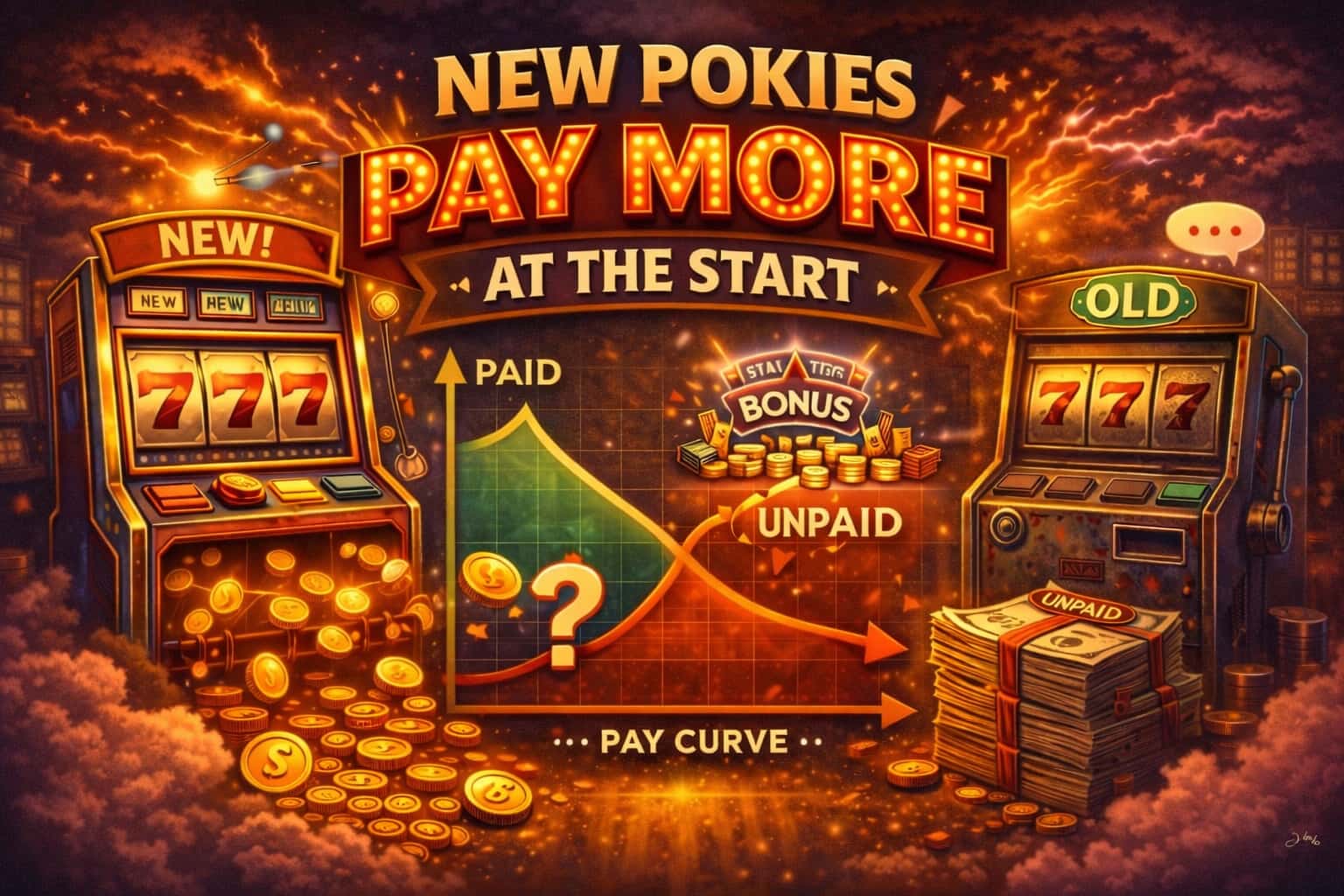
The belief that new pokies games pay more generously when they first launch is remarkably persistent. Players often describe brand-new titles as “loose,” claiming they deliver bonuses quickly before quietly tightening up once the initial buzz fades. It’s a comforting idea: play early, catch the good phase, then move on before the game turns against you.
What makes this myth convincing is not evidence, but visibility.
When a new pokie launches, far more people are playing it at the same time. Wins that would normally go unnoticed are suddenly shared in chats, screenshots, streams, and social posts. A handful of early successes can create the impression that the game is paying unusually well, even though those wins are statistically ordinary.
There’s also a psychological contrast effect at work. New pokies feel exciting. The visuals are unfamiliar, the features are unexplored, and expectations are high. Early wins feel amplified by novelty. When players return later and experience losses — as they inevitably will — the difference feels stark. The mind interprets that contrast as change rather than variance.
In regulated environments, the idea of “loosening” and “tightening” doesn’t hold up. pokies games are released with fixed RTP and audited parameters. Adjusting them after launch isn’t a quiet tweak; it would require formal changes, approval, and re-certification. The maths that governs the game is the same on day one as it is months later.
What actually changes over time is attention. Early play is remembered more vividly because it’s shared and discussed. Later play happens in isolation, without the same excitement or social reinforcement. Losses feel personal rather than collective, and without comparison points, they’re easier to attribute to the game rather than to randomness.
The myth also survives because it encourages action. Believing new pokies pay more gives players a sense of urgency and advantage. It transforms coincidence into opportunity and randomness into timing. Even when players know, intellectually, that it isn’t true, the idea feels plausible enough to influence behaviour.
New pokies don’t pay more at the start. They don’t ease players in or tighten the screws later. What changes is how closely results are observed, how loudly wins are shared, and how memory exaggerates early success. The myth persists because early variance is more visible — not because the game behaves differently.
6. “Casinos Tighten Pokies When They Want”
The idea that casinos tighten pokies at specific times of day is one of the most persistent and emotionally charged myths players share. Late at night, during busy weekends, after a big win, or when a venue feels crowded — these moments are often blamed when sessions turn sour. The implication is that timing matters, and that poor results are the product of external adjustment rather than chance.
This belief usually forms after a contrast in experience. A session earlier in the day feels positive or uneventful. A later session feels harsher, faster, or more expensive. Because time is the most obvious difference between the two, it becomes the explanation.
What’s actually changing in these situations is not the game, but the player. Later sessions often involve fatigue, longer play, or faster decision-making. Busy environments encourage shorter pauses and less reflection. Over time, these factors increase exposure to losses, making outcomes feel worse even when the probabilities are unchanged.
Modern pokies games do not adjust their behaviour based on time, traffic, or individual play. In regulated environments, RTP and game parameters are fixed and audited. A pokies does not know whether it is being played at noon or midnight, nor does it respond to how much has already been won or lost on it that day.
The myth survives because timing provides a comforting explanation. If losses are caused by external manipulation, they aren’t personal, random, or inevitable. They’re situational. That framing preserves the idea that good play is still possible — just at the right time.
Memory plays a role as well. Losing sessions are often remembered as blocks of time: that night, that weekend, that visit. Wins are remembered as events. Over time, this grouping reinforces the sense that time itself carries meaning, even though outcomes within those windows are random.
Believing in timing adjustments also gives players a sense of agency without requiring behavioural change. Instead of playing less, slowing down, or stopping earlier, the solution becomes scheduling — avoid bad hours, find good ones. The belief is easier to hold than the alternative explanation that losses arise from variance combined with extended play.
Casinos don’t tighten pokies at certain times. The odds don’t shift, and the games don’t react. What changes is how players feel, how long they play, and how much exposure they accumulate. The myth persists because it transforms randomness into something external and manageable, even when it isn’t.
7. “Some People Are Just Luckier”
Many players believe that luck belongs to individuals rather than to moments. They talk about friends who “always seem to win,” regulars who constantly hit bonuses, or strangers who sit down and walk away ahead. Over time, randomness turns into reputation, and coincidence becomes character.
This belief feels especially persuasive because it’s built on observation. Players aren’t imagining outcomes — they’re remembering them. When the same person wins repeatedly across a handful of sessions, it feels natural to assume something intrinsic is at work. Luck becomes a personal trait rather than a temporary statistical position.
What’s actually happening is short-term variance expressing itself unevenly across people. In any group of players, some will experience clusters of positive outcomes while others experience clusters of losses. When play is limited to dozens or hundreds of spins — as it usually is — those clusters can look stable and meaningful.
| What players notice | What’s really happening |
| One person wins often | Positive variance clustering |
| Another keeps losing | Negative variance clustering |
| Pattern feels consistent | Sample size is too small |
| Luck feels personal | Randomness is uneven |
Memory amplifies this effect. Wins are shared, talked about, and retold. Losses are quiet and quickly forgotten. Over time, stories accumulate around certain people, while the countless unremarkable sessions fade away. The result is a skewed perception of how often “lucky” players actually win.
Assigning luck to people also serves an emotional purpose. It creates distance between outcome and self. If someone else is lucky, then losing doesn’t feel like failure — it feels like bad fortune in comparison. The belief preserves fairness without forcing players to confront randomness directly.
What makes this myth durable is that it’s never cleanly disproven. Eventually, the “lucky” player loses. Eventually, the unlucky one wins. But those moments are treated as exceptions rather than corrections. The identity remains intact.
Some people aren’t luckier than others. They’re temporarily positioned on the favourable side of variance. Randomness doesn’t distribute experiences evenly, and when humans observe unevenness, they turn it into a narrative.
8. “Experience Improves Pokie Performance”
As players spend more time with pokies games, many begin to feel that experience gives them an edge. They know the features, recognise bonus structures instantly, and feel comfortable navigating sessions without hesitation. Over time, this familiarity can start to feel like competence — and competence can feel like improved performance.
This belief is understandable, but it rests on a subtle confusion between confidence and influence.
Experience genuinely does change how players interact with pokies. They become faster at understanding what’s happening on screen, less anxious about volatility, and more decisive about when to raise or lower stakes. These changes make play feel smoother and more controlled. What experience does not change is the probability governing outcomes.
pokies do not reward familiarity. They don’t learn player behaviour, adjust odds based on time spent, or respond differently to seasoned players. The same random number generator applies the same probabilities to every spin, regardless of who presses the button.
| What experience improves | What experience does not improve |
| Understanding of features | Chance of winning |
| Comfort during volatility | Bonus trigger rates |
| Confidence while playing | RTP or house edge |
| Recognition of myths | Outcome predictability |
The myth persists because confidence alters perception. Experienced players tend to attribute wins to good judgement and losses to bad luck. Newer players do the opposite. Over time, this self-attribution builds the impression that experience is producing results, even when outcomes are statistically identical.
There’s also a memory effect at work. Players remember early struggles vividly and later successes more clearly. The messy learning phase fades, while the feeling of fluency remains. This creates a false narrative of progression — as if understanding the game led to better outcomes rather than simply reducing uncertainty.
In some cases, experience can even reinforce myths. Familiar players often develop personal rules, habits, or instincts that feel earned through repetition. When these habits coincide with positive variance, they feel validated. When they don’t, the losses are rationalised or forgotten. Over time, belief hardens into conviction.
Experience makes pokies play feel easier, calmer, and more predictable. That alone can feel like improvement. But the underlying performance — measured in wins and losses over time — remains unchanged. What grows is comfort, not advantage.
9. Why Do These Myths Feel True?
What gives pokies myths their staying power isn’t ignorance or stubbornness — it’s alignment. Each myth aligns closely with how human perception works under uncertainty. pokies games create environments where outcomes are fast, uneven, and emotionally charged, and myths step in to make that experience feel coherent.
Randomness, as it actually behaves, is deeply unintuitive. It produces streaks, long droughts, sudden reversals, and apparent patterns that don’t settle quickly. For a human brain wired to expect balance and causality, this feels wrong. Something must be happening beneath the surface.
pokies myths provide ready-made explanations. A game isn’t just random — it’s due, cold, hot, or responding to behaviour. Losses aren’t just variance — they’re part of a cycle. Wins aren’t coincidence — they’re triggered by the right decision. Each belief reduces ambiguity and restores a sense of order.
What makes these myths especially compelling is that they rarely feel speculative. Players aren’t guessing; they’re interpreting lived experience. They’ve seen dry spells end. They’ve watched big wins land after stake increases. They’ve noticed certain players winning more often than others. Each observation is real — the conclusion drawn from it is where things go wrong.
| Experience during play | Psychological interpretation |
| Long losing streak | “It’s building toward a win” |
| Clustered wins | “The game is hot” |
| Big win after a change | “That decision mattered” |
| Repeated success by others | “They’re luckier or better” |
These interpretations feel reasonable because they are emotionally efficient. They reduce uncertainty, protect self-image, and make outcomes feel meaningful rather than arbitrary.
Design also plays a role. pokies are built around anticipation, near-misses, rapid feedback, and visible choice. These elements don’t create myths, but they reinforce the idea that outcomes are responsive. When a system looks interactive, players assume interaction matters.
Knowledge alone doesn’t dissolve these beliefs because they don’t operate at a logical level. A player can understand RNGs perfectly and still feel that a game is about to turn. The myth doesn’t argue with logic — it bypasses it by appealing to intuition and emotion.
In this sense, pokies myths aren’t mistakes to be corrected so much as stories the brain tells to stay comfortable in unpredictable environments. They persist because they work, emotionally, even when they fail mathematically.
10. Letting Go of Pokie Myths Without Losing Enjoyment
For many players, pokies myths aren’t just explanations — they’re part of the experience. They add texture to play, give shape to sessions, and soften the emotional impact of randomness. That’s why the idea of letting go of them can feel uncomfortable, even threatening. If the myths disappear, what’s left?
The answer is: the same uncertainty, excitement, and emotional rhythm — just without the pressure to interpret every outcome.
Enjoyment in pokies play doesn’t come from believing a game is due, hot, or responsive. It comes from anticipation, surprise, and the moment-to-moment tension of not knowing what will happen next. Those elements remain intact even when myths are recognised for what they are.
What changes is the relationship players have with outcomes. Wins stop feeling like proof of insight. Losses stop feeling like signals that something must be corrected. The session becomes an experience rather than a puzzle that needs solving.
Letting go of myths doesn’t require active resistance. In fact, trying to suppress them often makes them stronger. A more sustainable approach is simple recognition: noticing when a thought arises, understanding why it feels compelling, and choosing not to act on it.
| Myth-driven mindset | Awareness-driven mindset |
| “Something must change soon” | “This is variance playing out” |
| “I made the wrong move” | “The outcome was independent” |
| “Timing matters here” | “Timing feels meaningful, but isn’t” |
This shift doesn’t make play colder or more mechanical. If anything, it often reduces frustration. When outcomes are no longer treated as feedback on decision quality, sessions feel lighter. The emotional highs remain, but the lows lose some of their sting.
It’s also worth noting that myths don’t disappear overnight. Even players who understand randomness deeply still feel these beliefs during play. That’s normal. The goal isn’t to eliminate instinct, but to stop instinct from quietly steering behaviour.
pokies myths are best understood as coping mechanisms for unpredictability. They help people navigate systems that offer excitement without control. Letting them go doesn’t remove enjoyment — it removes the illusion that enjoyment depends on being right about what’s happening.
When players stop trying to read meaning into every spin, they often find that the experience becomes clearer, calmer, and more honest. The mystery remains — it’s just no longer mistaken for insight.
Frequently Asked Questions
Are pokies machines ever “due” to pay?
No. pokies machines do not become more likely to pay after a losing streak. Each spin is an independent event generated by a random number generator, meaning previous outcomes have no influence on future results. The feeling that a pokies is “due” comes from human discomfort with long losing runs, not from how the game works.
Do pokies really go hot and cold?
pokies do not cycle through hot or cold phases. What players interpret as hot streaks or cold periods are natural clusters created by randomness. Wins and losses often group together unevenly, which makes outcomes feel patterned even when they are not.
Does increasing your bet improve your chances of winning?
Increasing your bet does not improve your odds or trigger better outcomes. It only increases the size of potential wins and losses. The probability of hitting a bonus or winning combination remains the same regardless of stake size.
Can stopping the reels affect the outcome?
No. The outcome of a pokies spin is determined the moment the spin begins. Manually stopping the reels only changes how quickly the animation finishes. The result itself is already decided and cannot be influenced by timing.
Do new pokies games pay more when they launch?
New pokies do not pay more at the start. Early wins are more visible because more players are trying the game at the same time, and those wins are more likely to be shared or discussed. This creates the illusion of higher payouts, even though the RTP is fixed from launch.
Do casinos tighten pokies at certain times of day?
Casinos do not adjust pokies payouts based on time, crowd size, or recent wins. RTP and game settings remain constant. Sessions played later in the day often feel worse due to fatigue, longer play, or faster pacing, which increases exposure to losses.
Are some people genuinely luckier than others?
Some players appear luckier over short periods because randomness distributes outcomes unevenly. Given enough players, some will experience winning streaks while others lose repeatedly. Over time, these clusters even out, but short-term variance creates the illusion of personal luck.
Does experience improve pokies performance?
Experience improves familiarity and confidence, not outcomes. Experienced players may feel more comfortable during volatility and more decisive in play, but the odds remain unchanged. pokies performance does not improve with practice.
Why do pokies myths feel so convincing even when we know better?
pokies myths feel convincing because they align with how the human brain processes uncertainty. Randomness feels uncomfortable, and myths provide explanations that restore meaning, control, and emotional balance during play.