

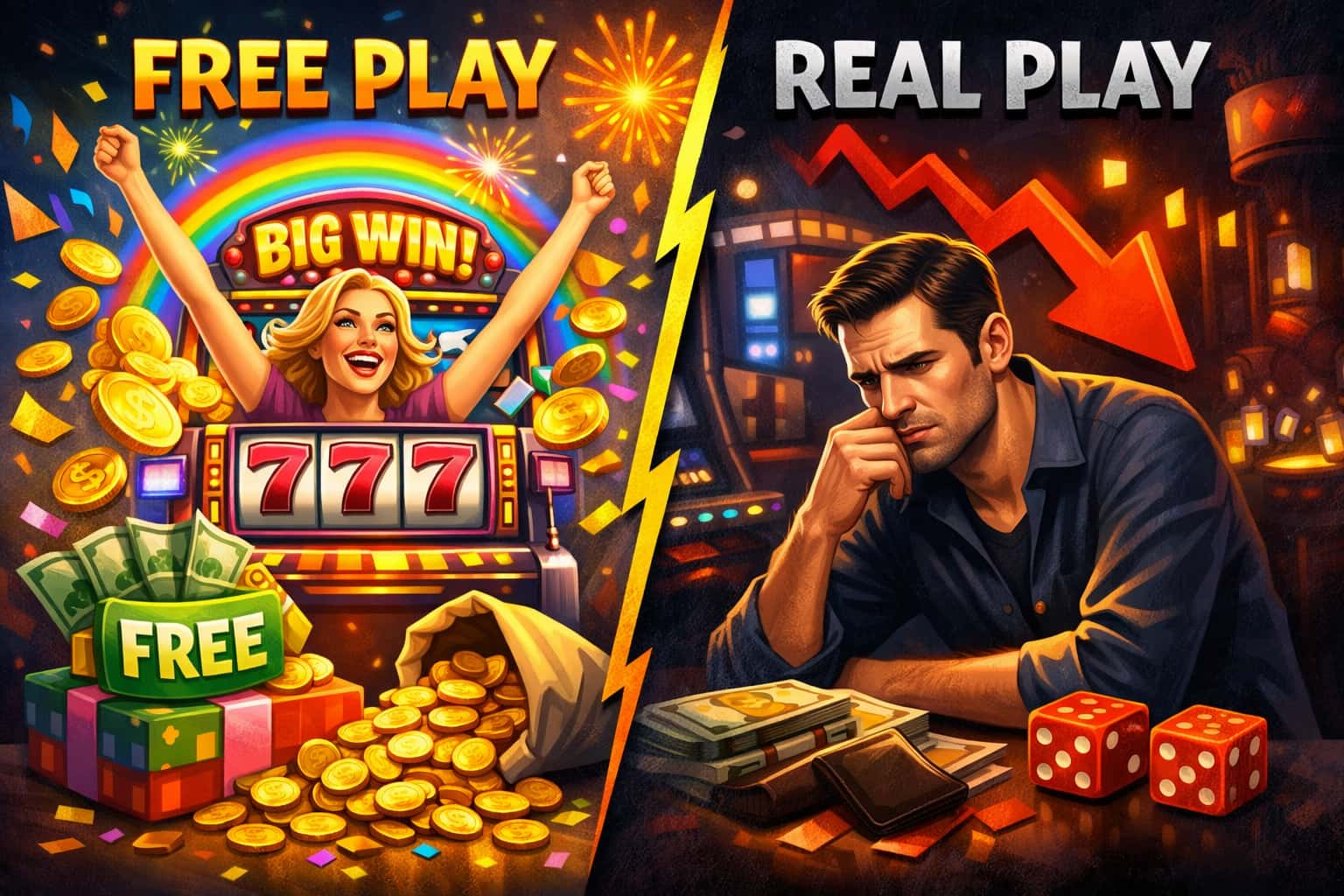
Most casino players notice the difference immediately. In free play, wins seem to land more often, bonuses feel easier to trigger, and sessions feel lighter and more rewarding. The same game, when played with real money, can feel harsher, colder, and far less forgiving. It’s common to hear players say that free spins are “looser” or that demo mode doesn’t reflect how a game really plays.
What makes this perception so compelling is that it feels observational rather than emotional. Players aren’t just feeling unlucky — they believe they’re seeing a genuine difference in behaviour between free play and real play. The assumption is that something about the game has changed.
In reality, the most important change isn’t in the software. It’s in the context.
Free play removes the single factor that dominates how gambling is experienced: loss. When there is no real downside to an outcome, wins and losses are processed differently. Variance feels playful rather than punishing. Dry spells feel temporary rather than frustrating. Even modest wins feel satisfying because they carry no cost.
This shift quietly reshapes perception. Without financial risk, attention narrows to positive moments. Losses fade quickly because they don’t register as consequences. Sessions often end earlier and on a higher note, leaving behind a cleaner, more optimistic memory. Over time, this creates the impression that free play is more generous, even when the underlying mechanics are identical.
The confusion deepens when online casino players move from free play into real-money sessions. Expectations formed in a risk-free environment collide with the emotional weight of real losses. The game feels different, not because it behaves differently, but because the experience now carries consequence.
This article explores why free play feels more generous than real play, even when odds, RTP, and volatility remain the same. We’ll look at how the absence of loss changes perception, why wins feel larger without risk, and how memory and emotion distort comparison between the two modes.
Understanding this difference doesn’t make free play useless — it clarifies what it’s actually good for, and why treating it as a preview of real-money experience almost always leads to disappointment.
What We Mean by Free Play
When players talk about free play, they’re usually referring to a handful of different experiences that all share one defining feature: no personal money is at risk. That single condition is what separates free play from real play — and it’s what drives almost every difference in how the experience feels.
Free play can take several forms. Demo mode allows players to spin with virtual credits that have no monetary value. Free spins promotions let players use bonus credits that can’t be withdrawn directly. Some platforms also offer practice balances or trial modes that simulate real stakes without real consequences. Although these formats differ slightly, they all remove the emotional weight of loss.
This distinction matters because players often compare free play and real play as if they’re equivalent environments with different outcomes. They aren’t. Free play isn’t just real play without money — it’s a fundamentally different psychological context.
In free play, outcomes don’t carry personal cost. A losing spin doesn’t reduce something you earned. A dry spell doesn’t feel like a setback. Even a complete balance wipe feels abstract, because nothing tangible has been lost. As a result, attention shifts almost entirely to wins, features, and moments of excitement.
Real play reverses that balance. Losses now matter. Each spin carries the possibility of regret, frustration, or self-judgement. The same sequence of outcomes that felt harmless in free play can feel punishing when money is involved, even if the maths hasn’t changed at all.
It’s also worth noting that free play is usually experienced differently in time. Players tend to dip in briefly, explore features, trigger a bonus or two, and leave. Sessions are often shorter and less emotionally charged. Real-money sessions, by contrast, are more likely to continue through losing phases, exposing players to a wider range of variance.
This difference in structure creates a misleading comparison. Free play often shows only the most engaging parts of a game, while real play exposes everything in between. When players later say that free play felt more generous, they’re often comparing a highlight reel to a full session.
Free play isn’t deceptive by design, but it is incomplete as a representation of real-money experience. Understanding what free play actually is — and what it isn’t — is the first step toward understanding why it feels so much kinder than the real thing.
The Absence of Loss Changes Everything
The most important difference between free play and real play is not how often wins occur, but how losses are experienced. When nothing of value can be lost, the emotional architecture of the session changes completely. The same outcomes land, but they don’t register in the same way.
In free play, a losing spin is informational at most. It resolves visually, then disappears. There is no internal reckoning about cost, no sense of opportunity lost, and no pressure to justify continuing or stopping. The brain treats the outcome as neutral noise.
Real play introduces consequence. Every losing spin now represents something given up, however small. Over time, these micro-losses accumulate emotional weight. The player becomes more aware of balance movement, more sensitive to dry spells, and more likely to interpret outcomes as signals rather than randomness.
Several subtle shifts happen as soon as loss is removed:
- Attention narrows toward wins and features
- Patience increases during dry spells
- Frustration is delayed or absent
- Sessions end earlier, often on positive moments
None of these change probability, but all of them change what the player notices and remembers.
This contrast becomes clearer when the same outcomes are placed side by side.
| Free play | Real play |
| Losses feel abstract | Losses feel consequential |
| Wins stand out clearly | Wins compete with loss awareness |
| Dry spells feel tolerable | Dry spells feel punishing |
| Sessions end easily | Sessions persist through losses |
Because free play removes the downside, it also removes the emotional counterweight that normally tempers wins. A bonus in free play feels like pure upside. In real play, that same bonus is often interpreted as partial recovery or relief, especially if it arrives after a losing run.
The absence of loss also affects how variance is interpreted. In free play, long stretches without success don’t demand explanation. In real play, they invite it. Players begin to question timing, decisions, or the game itself, even though nothing has changed beneath the surface.
What this creates is not a more generous game, but a cleaner experience. Free play filters out the most uncomfortable aspects of variance by stripping them of consequence. When players later describe free play as kinder or luckier, they’re often responding to that absence rather than to any difference in outcomes.
Free play feels more generous because it removes the one thing that makes gambling emotionally difficult. Without loss, the experience naturally tilts toward the positive — not because the game behaves differently, but because the player does.
Loss Aversion and Emotional Weight
Free play and real play don’t just feel different because of money — they feel different because of how the brain responds to loss. Humans are loss-averse by default. We feel losses more strongly than equivalent gains, and that imbalance quietly shapes how gambling sessions are experienced and remembered.
In real play, every losing spin carries emotional weight out of proportion to its size. A small loss doesn’t feel small when it happens repeatedly. Each spin becomes part of a running tally, and that tally colours how wins are interpreted. A modest win may feel disappointing if it follows a series of losses, even though it would feel satisfying in isolation.
Free play short-circuits this mechanism. When losses don’t subtract from anything meaningful, loss aversion never fully activates. Outcomes that would feel negative in real play pass through the mind almost unnoticed. The emotional system remains skewed toward upside.
This has several knock-on effects that players rarely notice in the moment:
- Wins are evaluated on their own terms, not against prior losses
- Losses fail to accumulate emotional momentum
- Variance feels smoother and less confrontational
- Sessions feel less demanding and less tense
None of this changes the number of wins or losses — it changes how strongly each outcome is felt.
Loss aversion also explains why real play often feels harsher even when results are objectively similar. In free play, a bonus after a dry spell feels like a pleasant surprise. In real play, that same bonus can feel overdue, insufficient, or merely corrective. The win isn’t judged by what it is, but by what it undoes.
This difference feeds directly into perception of generosity. A game that produces identical outcomes in free and real play can feel wildly different because the emotional accounting is different. Free play tallies only positives. Real play tallies everything.
What makes this especially misleading is that players often attribute the emotional shift to the game rather than to themselves. The logic becomes: this slot paid better in free play, rather than losses mattered less in free play. The game is blamed or praised for a psychological response it didn’t create.
Loss aversion doesn’t turn off just because players understand it. Even experienced players who know the odds feel its effects. Free play simply bypasses it by removing the trigger. That absence makes everything downstream — wins, bonuses, and even long dry spells — feel lighter and more generous than they ever will with real money on the line.
Why Wins Feel Bigger in Free Play
One of the most common reactions players have to free play is surprise at how satisfying even modest wins feel. A small line hit, a minor bonus, or a short feature run can feel disproportionately rewarding. When the same outcomes appear in real play, they often feel muted or even disappointing.
The difference isn’t in the win itself. It’s in what the win is being measured against.
In free play, wins are evaluated in isolation. There’s no emotional ledger tracking what came before. A £10 equivalent win in demo mode doesn’t need to recover losses, justify spending, or restore balance. It simply exists as a positive moment, unburdened by context.
Real play adds that context immediately. Wins are rarely judged on their own. Instead, they’re weighed against recent losses, session totals, and expectations. A win that would feel generous in free play can feel underwhelming if it follows a long losing run or fails to move the balance meaningfully.
Several factors combine to amplify wins in free play:
- There’s no sense of recovery or “catching up”
- Expectations are lower and more flexible
- Losses don’t dilute the emotional impact of gains
- Attention is fully available to the win itself
This creates a kind of emotional magnification. Wins stand alone, rather than competing with frustration or regret.
There’s also a subtle timing effect. Free play sessions often end shortly after a positive event. Players explore a game, trigger a feature, enjoy the novelty, and leave. That ending point matters. The session is remembered as a win-focused experience, even if it contained many losing spins beforehand.
In real play, sessions are more likely to continue through negative phases. Wins arrive mid-stream, surrounded by losses that dull their impact. Even a decent payout can feel like a pause in a losing trend rather than a satisfying outcome.
This difference feeds directly into the perception of generosity. A game that produces identical outcomes across modes can feel far more giving in free play because wins aren’t being asked to do anything. They don’t need to compensate, correct, or justify. They’re simply enjoyed.
When players later compare free play to real play, they’re often comparing isolated wins to contextualised wins. One feels pure. The other feels conditional. The game hasn’t changed — the emotional arithmetic has.
Risk Perception vs Actual Probability
One of the most persistent misunderstandings around free play is the belief that it changes the odds. Players often assume that demo modes or free spins are more generous because they feel safer, smoother, and more rewarding. That feeling is real — but it doesn’t come from probability.
The key distinction is between risk perception and actual probability. Probability governs what the game can return over time. Risk perception governs how those outcomes are experienced in the moment. Free play alters the latter without touching the former.
In free play, there is no downside to risk. A volatile game doesn’t feel volatile when its swings don’t cost anything. Large losses don’t register as danger signals, so the brain never flags the experience as risky. Without that warning system activating, outcomes feel tamer and more forgiving.
Real play activates risk perception immediately. Even small bets carry consequences, which sharpens attention and heightens emotional response. Variance feels more aggressive, not because it is stronger, but because the player is now exposed to it.
This contrast is easier to see side by side.
| Aspect | Free play | Real play |
| Actual odds | Identical | Identical |
| Financial risk | None | Present |
| Emotional response | Low | High |
| Perceived volatility | Softer | Harsher |
| Tolerance for swings | High | Lower |
The table highlights an important point: nothing mathematical changes. RTP, hit rates, and volatility profiles remain the same. What changes is how much those properties matter to the player.
Risk perception also influences attention. In free play, players are more willing to accept long dry spells because there’s nothing to lose by waiting them out. In real play, those same dry spells feel threatening. Each spin becomes a decision rather than an exploration.
This difference often leads to a mistaken conclusion. Players think, this game plays differently for real money, when what’s actually happening is that risk has finally entered the picture. The game hasn’t become tighter — the stakes have become real.
Understanding this gap helps explain why free play creates unrealistic expectations. It presents probability without consequence, which is not how gambling is ever experienced with real money. The odds don’t change, but the way those odds are felt changes dramatically.
Free play feels more generous because risk feels absent. Real play feels harsher because risk is finally doing what it’s meant to do: making outcomes matter.
Short Sessions and Memory Bias
Another reason free play feels more generous is that it’s rarely experienced in the same way as real play. Free sessions tend to be shorter, more exploratory, and more likely to end on a positive note. That structure quietly shapes how the experience is remembered.
When players use free play, they’re often sampling a game rather than committing to it. They spin for a few minutes, see a feature trigger, enjoy the novelty, and move on. There’s no pressure to recover losses or justify time spent. If nothing interesting happens quickly, they simply stop.
Real play doesn’t afford the same flexibility. Once money is involved, sessions are more likely to continue through losing phases. Players feel an urge to give the game “enough time,” to wait for something meaningful to happen, or to balance out earlier losses. As a result, real play exposes players to a fuller — and often harsher — range of variance.
Memory compounds this difference. Humans don’t remember sessions evenly; they remember highlights and endings. Free play sessions often contain clear highlights and clean exits, which makes them easier to recall positively. Real-money sessions blur together, especially when they include long stretches of unremarkable losses.
Several memory effects reinforce this imbalance:
- Free play is remembered for its best moments
- Loss-heavy periods are mentally skipped or compressed
- Ending on a win colours the entire session
- Long, uneven real sessions feel worse in hindsight
Over time, these remembered experiences are compared as if they were equivalent. A short, win-heavy free session is mentally stacked against a long, loss-exposed real session. The conclusion feels obvious: the free version was better.
What’s misleading is that free play isn’t showing the whole picture. It’s showing a curated slice of the game — the part that’s most engaging early on. Real play shows everything, including the stretches that free play users rarely sit through.
This memory bias doesn’t require exaggeration or selective honesty. It happens automatically. The brain prioritises emotionally clear moments and discards the rest. Free play produces more of those moments per minute simply because sessions are shorter and stakes are absent.
When players later say that free play felt more generous, they’re often remembering it accurately — just incompletely. They recall what stood out, not what would have happened had they stayed longer under real conditions.
RTP, Volatility, and Demo Mode Myths
One of the most common explanations players reach for when free play feels more generous is that demo modes must be running on different settings. The assumption is that RTP is higher, volatility is lower, or that the game is tuned to be friendlier when no real money is involved.
It’s an understandable conclusion, but it’s not how modern pokies are built.
In almost all regulated environments, demo mode and real play run on the same mathematical model. RTP doesn’t quietly increase. Volatility doesn’t soften. The random number generator doesn’t switch behaviour depending on whether the balance is real or virtual. The game logic remains identical.
What changes is how those properties are experienced.
RTP is a long-term average, not a session guarantee. Volatility describes how results are distributed, not how they’ll feel in a short run. In free play, players rarely stay long enough for either concept to express itself fully. In real play, they often do.
This gap between theory and experience fuels several persistent myths:
| Common belief | What’s actually happening |
| Demo mode pays more | Sessions are shorter |
| Free play is less volatile | Losses don’t register emotionally |
| RTP feels higher | Variance hasn’t had time to bite |
| Real play is “tighter” | Risk is finally present |
Another factor is expectation. In free play, players expect exploration, not results. In real play, they expect value. When expectations rise, disappointment becomes more likely, even if outcomes are statistically normal.
It’s also worth noting that demo play removes pressure to continue. Players leave early if nothing happens. In real play, they often stay through losing stretches, which makes volatility far more visible. The game hasn’t changed — the exposure has.
The myth that demo modes are tuned differently survives because it offers a technical explanation for an emotional experience. It feels more satisfying to believe the software changed than to accept that perception did.
Understanding RTP and volatility at a conceptual level doesn’t eliminate this confusion. These ideas are abstract and slow-moving. Free play and real play are immediate and emotional. When the two clash, experience usually wins.
Free play doesn’t alter the maths. It alters the conditions under which the maths is felt. That distinction explains why demo mode feels kinder without requiring any hidden adjustments behind the scenes.
Why Players Chase the Free Play Feeling
Once players experience how relaxed and rewarding free play feels, it’s natural to want that feeling to carry over into real play. The problem is that what’s being chased isn’t a pattern of outcomes — it’s a state of mind that only exists when consequences are absent.
Free play feels light. There’s no urgency, no tension, and no sense of responsibility for what happens next. Spins feel exploratory rather than decisive. Wins feel like gifts rather than recoveries. That emotional texture is enjoyable in its own right, and it leaves a strong impression.
When players move into real play, they often expect the same rhythm. They choose the same game, play in a similar way, and hope the experience will feel familiar. When it doesn’t, the disappointment can be sharp. The game feels harsher, less responsive, even unfair — not because it has changed, but because the emotional safety net is gone.
What players are often chasing, without realising it, is:
- The absence of pressure
- The freedom to lose without consequence
- The ability to enjoy wins without context
- The sense that nothing is at stake
These conditions cannot exist once money is involved.
This mismatch creates frustration. Players may increase stakes to force excitement, switch games to recapture novelty, or extend sessions trying to recreate the easy generosity of free play. Each attempt moves them further from the experience they’re trying to return to.
What makes this cycle difficult to recognise is that it doesn’t feel irrational. The player isn’t chasing losses — they’re chasing familiarity. They’re trying to return to a version of the game that felt better, smoother, and more forgiving.
Free play sets an emotional benchmark that real play cannot meet by design. Expecting real-money sessions to feel the same is like expecting practice to feel like performance without the pressure. The presence of risk fundamentally alters the experience.
Understanding this doesn’t mean free play is misleading or harmful. It simply means it serves a different purpose. It’s a place to explore, to learn mechanics, and to enjoy the surface of a game without cost. When that purpose is confused with prediction, disappointment becomes inevitable.
Players chase the free play feeling because it’s genuinely pleasant. The mistake is believing that the feeling reflects how the game will behave once the stakes are real.
The Transition From Free to Real Play
The moment players move from free play to real play is often where the disconnect becomes most obvious. Nothing about the game itself appears to change, yet the experience can feel immediately harsher. Spins feel riskier. Losses feel sharper. Wins feel less satisfying. For many players, this shift is confusing and frustrating.
What’s happening in that transition isn’t a change in behaviour from the game — it’s a change in reference point.
Free play establishes a baseline where outcomes are emotionally light and largely positive. Real play then replaces that baseline with one where outcomes carry consequence. When players compare the two, they’re not comparing like for like. They’re comparing an experience without cost to one where cost is ever-present.
This is why the transition often feels unfair. Players expect continuity. They assume that if a game felt generous in free play, it should feel similar once money is involved. When it doesn’t, the conclusion is often that something has been taken away or tightened.
In reality, what’s been added is pressure.
Real play forces every outcome to be evaluated. A losing spin isn’t just an animation — it’s money gone. A win isn’t just a reward — it’s weighed against what it followed. That constant evaluation changes the tone of the entire session. Free play never demands that level of accounting.
Another factor is commitment. Real play sessions tend to last longer, not because players are enjoying themselves more, but because stopping now carries emotional weight. Leaving after losses feels unresolved. Free play allows clean exits. Real play resists them.
This makes the transition feel like a drop in generosity when it’s actually a shift in exposure. Real play simply reveals more of the game — including the stretches free play users rarely sit through. The generosity of free play wasn’t false; it was incomplete.
Understanding this transition helps reframe the disappointment many players feel. The issue isn’t that real play is worse than free play. It’s that free play is a filtered version of the experience, stripped of consequence and pressure. Expecting that filter to persist once money is involved sets players up for frustration.
Recognising the difference doesn’t make real play easier or free play less enjoyable. It simply removes the assumption that one is a reliable preview of the other.
Enjoying Free Play Without Misreading It
Free play isn’t misleading, but it is often misunderstood. Its value lies in exploration, not prediction. When players approach it as a way to sample mechanics, themes, and features, it does its job well. Problems arise only when free play is treated as evidence of how a game will behave once real money is involved.
Understanding what free play removes — loss, pressure, and consequence — helps explain why it feels so generous. It’s not that free play offers better outcomes. It’s that it strips away the emotional costs that usually accompany those outcomes. Wins feel cleaner. Losses fade faster. Sessions end more neatly.
Real play can never replicate that experience, because risk changes everything. Once money is involved, outcomes demand interpretation. Losses invite justification. Wins carry expectations. The game becomes something to manage rather than something to sample.
Enjoying free play without misreading it means letting it remain what it is: a low-stakes environment for curiosity. It’s a way to learn how a game looks and moves, not how it will treat you over time. When those boundaries are clear, free play can be enjoyable without setting unrealistic expectations.
For players who understand this distinction, the transition into real play becomes less jarring. The game doesn’t feel like it has changed, only that the rules of engagement have. That awareness doesn’t guarantee satisfaction, but it does reduce confusion and misplaced disappointment.
Free play feels more generous because it removes the hardest part of gambling. Real play feels harsher because it brings it back. Recognising that difference doesn’t take away the fun — it just puts it in the right place.
Frequently Asked Questions
Does free play use different odds than real play?
No. In regulated environments, free play and real play use the same RTP and volatility settings. The difference lies in how outcomes are experienced, not in how the game is programmed.
Why do I seem to win more often in free play?
Wins stand out more in free play because losses carry no consequence. Without loss aversion activating, positive outcomes feel more frequent and more satisfying, even when the hit rate is the same.
Is free play designed to make games look better?
Free play isn’t designed to deceive, but it does remove pressure, cost, and emotional weight. That makes the experience feel smoother and more generous than real play, even though the maths doesn’t change.
Does RTP behave differently in demo mode?
No. RTP is a long-term average that doesn’t guarantee short-term results. Free play sessions are usually too short for RTP to express itself meaningfully, which can make outcomes feel skewed.
Why does real play feel harsher after free play?
Real play introduces financial risk, which activates loss aversion and heightens emotional response. The same outcomes feel heavier because they now matter.
Should free play be used to judge whether a game is “good”?
Free play is useful for learning mechanics, features, and pacing, but it’s not a reliable way to judge how a game will feel over extended real-money sessions.