

Speed is one of the most overlooked influences on gambling behaviour. Players often focus on odds, RTP, or volatility, assuming these are the primary forces shaping outcomes. In reality, how quickly decisions are made often has a stronger effect on behaviour than probability itself.
Fast-paced gambling environments compress time. Spins resolve quickly, bets repeat instantly, and outcomes arrive before players have time to reflect on what just happened. Over time, this speed subtly changes how decisions are made, how risks are perceived, and how losses and wins are emotionally processed.
Importantly, speed doesn’t change the mathematics of a game. The odds remain the same whether a spin takes two seconds or ten. What changes is how the brain responds. Faster play reduces reflection, increases reliance on instinct, and weakens the mental checkpoints that normally slow decision-making.
This is why players often describe fast games as:
- More immersive
- More intense
- Easier to lose track of time in
And also why faster play is associated with higher turnover, quicker bankroll movement, and stronger emotional swings — even when stakes and odds remain unchanged.
In this article, we’ll examine how speed affects player behaviour at a psychological level. We’ll look at spin speed, autoplay, decision fatigue, emotional regulation, and why pace can matter more than odds in shaping real-world outcomes. The goal isn’t to criticise fast play, but to understand how it influences decisions, often without players realising it.
Spin Speed Differences
Spin speed defines how quickly a gambling game cycles through decisions. Each cycle includes placing a bet, waiting for the outcome, and deciding what to do next. When this cycle is shortened, decision-making changes — even if players don’t consciously notice it.
Faster spin speeds don’t change odds. They change tempo.
How Spin Speed Varies Across Games
| Game Type | Typical Spin / Round Time | Decision Frequency |
| Slow pokies | 5–7 seconds | Low |
| Standard pokies | 3–5 seconds | Medium |
| Fast pokies / turbo | 1–2 seconds | High |
| Live dealer games | 15–30 seconds | Low |
The faster the cycle, the more decisions a player makes per minute.
Why Faster Spins Feel Easier
Shorter spin times:
- Reduce waiting and anticipation
- Keep attention locked on the screen
- Minimise time for reflection
This creates a sense of flow where decisions feel automatic rather than deliberate.
Compressed Feedback Loops
Fast spins compress the feedback loop:
- Bet
- Result
- Next bet
With less time between outcomes, players are more likely to act on momentum instead of evaluation.
Faster Spins and Perceived Control
Rapid spins can also:
- Make outcomes feel less significant
- Reduce the emotional impact of single losses
- Encourage “just one more” behaviour
This combination makes faster games feel smoother and less risky in the moment, even when total risk increases.
Spin Speed and Behavioural Drift
Over time, fast spins lead to:
- More bets per session
- Less conscious decision-making
- Greater reliance on habit
Players often don’t notice the shift — they simply feel more engaged.
Key Takeaway
Spin speed doesn’t affect the maths of a game, but it strongly affects behaviour. Faster spins compress decision time, reduce reflection, and increase the number of bets placed — laying the groundwork for all other speed-related effects.
Autoplay and Reduced Deliberation
Autoplay removes one of the few natural pauses in gambling: the moment where a player decides whether to continue. By automating spins or rounds, autoplay changes gambling from a sequence of decisions into a continuous process.
The maths stays the same. The mental experience does not.
What Autoplay Actually Does
Autoplay typically:
- Repeats bets automatically
- Maintains consistent stake size
- Removes manual confirmation between spins
This eliminates the need for active choice on each round.
Manual Play vs Autoplay
| Aspect | Manual Play | Autoplay |
| Decision frequency | Every spin | Once per session |
| Pause between bets | Present | Minimal or none |
| Awareness of losses | Higher | Lower |
| Sense of control | Active | Passive |
Autoplay shifts players from decision-makers to observers.
Why Reduced Deliberation Matters
When players don’t need to decide repeatedly:
- Fewer mental checkpoints exist
- Losses blend together
- Wins feel less distinct
This reduces the chance that players stop to reassess.
Autoplay and Time Perception
Autoplay often distorts time:
- Sessions feel shorter than they are
- Progress feels continuous
- Stopping feels arbitrary
Without frequent decision points, players lose natural cues for when to pause or stop.
Emotional Flattening Effect
Autoplay can:
- Dampen emotional response to single outcomes
- Encourage longer sessions
- Increase total turnover without feeling riskier
Because emotions are less intense per spin, play feels calmer — even as exposure increases.
Why Autoplay Feels Safer Than It Is
Consistency creates comfort. When bets repeat automatically:
- Outcomes feel predictable
- Risk feels contained
- Losses feel gradual
In reality, automation simply accelerates exposure to variance.
Key Takeaway
Autoplay doesn’t change odds, but it removes deliberation. By reducing active decision-making and natural pauses, it allows sessions to run longer and faster — often without players noticing how much has changed.
Decision Fatigue Due To Fast Play
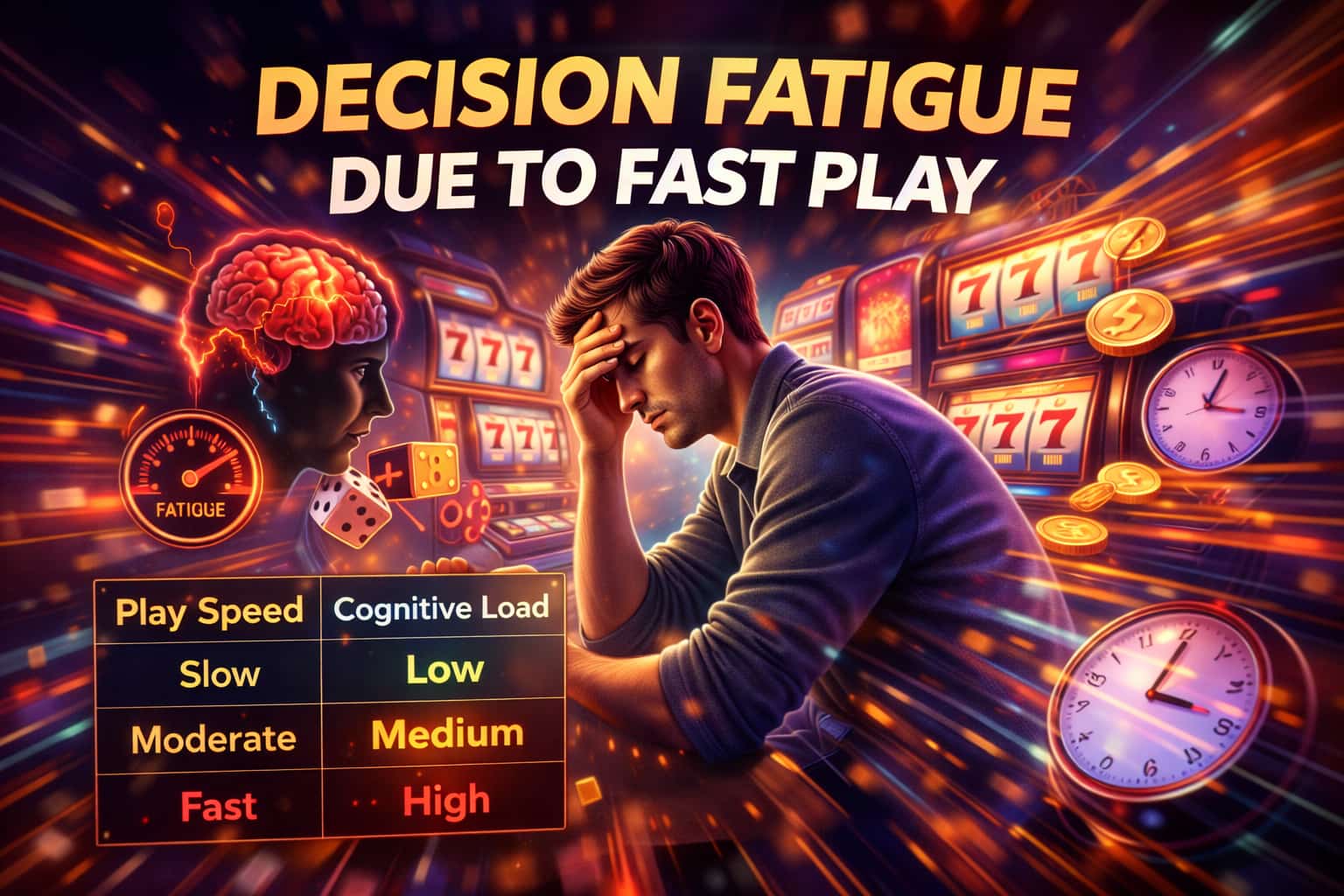
Every gambling action requires a decision, even if it feels automatic. Over time, making many rapid decisions without breaks leads to decision fatigue — a state where judgement weakens and choices become more impulsive.
Faster play accelerates this process.
What Decision Fatigue Looks Like
Decision fatigue doesn’t feel like tiredness. It feels like:
- Reduced patience
- Increased risk-taking
- Less evaluation of outcomes
- A tendency to “go with the flow”
As fatigue sets in, players rely more on habit than reflection.
Speed and Cognitive Load
| Play Speed | Decisions per Session | Cognitive Load |
| Slow | Fewer | Low |
| Moderate | Manageable | Medium |
| Fast | Many | High |
The faster the game, the more decisions are compressed into the same amount of time.
Why Faster Play Weakens Judgement
Rapid decisions:
- Leave little time to reassess
- Reduce awareness of cumulative loss
- Encourage automatic continuation
Players stop asking, “Should I keep playing?” and start acting on momentum.
Fatigue and Risk Tolerance
As decision fatigue increases:
- Risk tolerance rises
- Loss aversion weakens
- Stake increases feel easier
This shift is subtle but powerful, especially during longer fast-paced sessions.
The Illusion of Control During Fatigue
Ironically, fatigued players often feel more confident:
- Decisions feel smoother
- Doubt decreases
- Stopping feels disruptive
This confidence isn’t skill — it’s reduced scrutiny.
Key Takeaway
Fast play accelerates decision fatigue by compressing many choices into short periods. As fatigue sets in, judgement weakens, risk tolerance rises, and players are more likely to continue without conscious evaluation — even when outcomes worsen.
Faster Pace, Higher Turnover
One of the most direct consequences of speed is increased turnover — the total amount of money wagered over a session. Faster play doesn’t change the size of individual bets, but it dramatically increases how many bets are placed in the same amount of time.
This increase often goes unnoticed by players because it doesn’t feel like taking on more risk.
What Turnover Really Means
Turnover is not how much you win or lose — it’s how much money passes through the game.
For example:
- £1 per spin × 100 spins = £100 turnover
- £1 per spin × 500 spins = £500 turnover
The bet size hasn’t changed. Exposure has.
Speed vs Turnover
| Spin Speed | Spins per Minute | Approx. Hourly Turnover (£1 stake) |
| Slow | 10 | £600 |
| Medium | 20 | £1,200 |
| Fast | 40 | £2,400 |
Faster play quietly multiplies exposure, even at modest stakes.
Why Higher Turnover Doesn’t Feel Riskier
Higher turnover often feels harmless because:
- Individual bets remain small
- Losses arrive in fragments
- Wins interrupt loss perception
Players focus on balance movement, not on how much has been wagered in total.
Turnover and Variance Exposure
Higher turnover means:
- More exposure to variance
- Faster encounter with losing streaks
- Quicker bankroll movement
These effects are statistical, not emotional — which is why they often go unnoticed until the session ends.
The “Same Stakes” Fallacy
Players often assume:
“I didn’t increase my bet, so I didn’t increase my risk.”
In reality, speed increases risk by increasing how often probability is applied.
Key Takeaway
Faster pacing increases turnover by multiplying the number of bets placed. Even with the same stake size, speed increases exposure to variance and expectation — without triggering the same risk awareness as raising bets.
Emotional Regulation Issues
Emotional regulation is the process by which players notice wins, absorb losses, and adjust behaviour accordingly. Slower games naturally support this process by building in pauses. Faster games weaken it.
When outcomes arrive too quickly, emotions don’t have time to settle before the next decision is made.
How Slower Play Regulates Emotion
In slower-paced games:
- Wins have time to register
- Losses trigger reflection
- Pauses allow emotional reset
These moments act as natural brakes on impulsive behaviour.
What Fast Play Disrupts
Fast play removes or shortens these brakes:
- Losses blur together
- Wins feel fleeting
- Emotional reactions overlap
This makes it harder for players to accurately assess how they feel about the session.
Emotional Feedback at Different Speeds
| Play Speed | Emotional Processing | Behavioural Effect |
| Slow | Clear | Measured decisions |
| Moderate | Partial | Occasional reassessment |
| Fast | Blunted | Momentum-driven play |
As emotional feedback weakens, behaviour becomes less responsive to outcomes.
Why Losses Don’t “Land” Emotionally
In fast-paced sessions:
- Losses don’t feel individually significant
- Cumulative loss is underestimated
- Stopping feels arbitrary
This delay in emotional response often results in players realising how much they’ve lost only after the session ends.
The Momentum Effect
Fast play encourages momentum:
- Continuing feels easier than stopping
- Pausing feels disruptive
- Ending a session feels premature
Momentum replaces evaluation as the driver of behaviour.
Key Takeaway
Speed weakens emotional regulation by compressing outcomes and removing natural pauses. When emotions don’t have time to process, decisions become momentum-driven — even when results are deteriorating.
Why Speed Matters More Than Odds
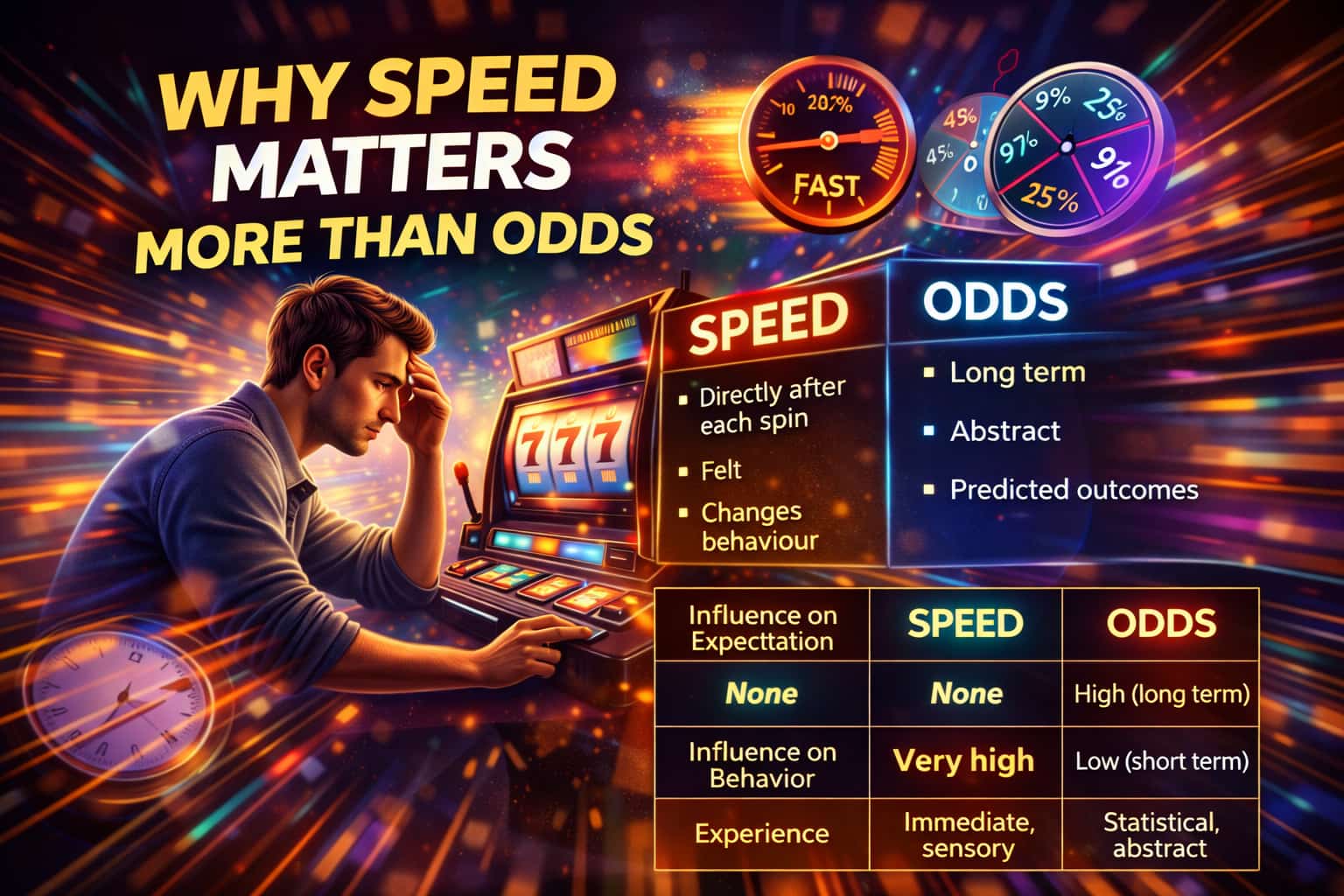
Most players believe odds are the primary driver of outcomes. While odds determine long-term expectation, speed determines behaviour in the moment — and behaviour is what shapes real-world results.
In practice, players don’t respond to probability. They respond to how quickly outcomes arrive.
Odds Are Abstract, Speed Is Felt
Odds are:
- Invisible
- Long-term
- Statistical
Speed is:
- Immediate
- Sensory
- Experiential
Because speed is directly felt, it has a stronger influence on decision-making than numbers most players never consciously calculate.
How Speed Overrides Rational Assessment
At higher speeds:
- There’s no time to reflect on odds
- Outcomes feel isolated rather than cumulative
- Risk is evaluated emotionally, not logically
This leads players to feel safe even when exposure increases.
Speed vs Odds in Practice
| Factor | Influence on Expectation | Influence on Behaviour |
| Odds | High (long term) | Low (short term) |
| Speed | None | Very high |
| Volatility | High | Medium |
| Stake size | High | High |
Speed shapes how often decisions are made and how consciously they’re evaluated.
Why “Good Odds” Don’t Protect Against Fast Play
Even favourable odds don’t prevent:
- Decision fatigue
- Increased turnover
- Momentum-driven behaviour
A slower game with worse odds may result in more controlled play than a faster game with better odds.
Perception of Control at High Speed
Fast games can create a false sense of control:
- Decisions feel fluid
- Doubt decreases
- Play feels “smooth”
This smoothness is often mistaken for confidence or skill.
Key Takeaway
Odds determine what can happen over time. Speed determines what does happen in a session. Because speed directly shapes behaviour, it often has a greater practical impact on outcomes than probability itself.
Responsible Pacing
Responsible pacing isn’t about avoiding fast games or forcing artificial limits. It’s about understanding how speed changes behaviour and choosing a pace that keeps decision-making intentional rather than automatic.
Slowing down doesn’t change the odds. It changes how you interact with them.
What Pacing Actually Influences
Pacing affects:
- How often you reassess play
- How clearly losses and wins register
- How much momentum drives decisions
It does not affect:
- RTP
- House edge
- Volatility profile
This distinction matters, because pacing is about behaviour, not advantage.
Natural Pauses vs Artificial Stops
| Type of Pause | Effect on Behaviour |
| Natural (manual spins, longer animations) | Encourages reflection |
| Artificial (forced pop-ups) | Often ignored |
| Self-chosen (intentional slowing) | Most effective |
Pauses work best when they’re part of the flow, not interruptions.
Why Slowing Down Changes Experience
Reducing speed:
- Restores emotional feedback
- Makes losses feel “real” sooner
- Breaks momentum
This often leads to earlier, more conscious decisions about whether to continue.
Pacing and Session Awareness
At a comfortable pace, players are more likely to:
- Notice time passing
- Track cumulative results
- Feel when attention drops
Fast play masks all three.
Choosing Pace Based on Tolerance
Responsible pacing isn’t about a universal speed. It’s about matching pace to:
- Emotional tolerance
- Attention span
- Session length expectations
When pace exceeds tolerance, behaviour shifts from choice to habit.
Key Takeaway
Responsible pacing doesn’t protect players from risk — it protects them from automatic behaviour. By choosing a pace that preserves awareness, players keep decision-making intentional rather than momentum-driven.
Awareness Tips for Players
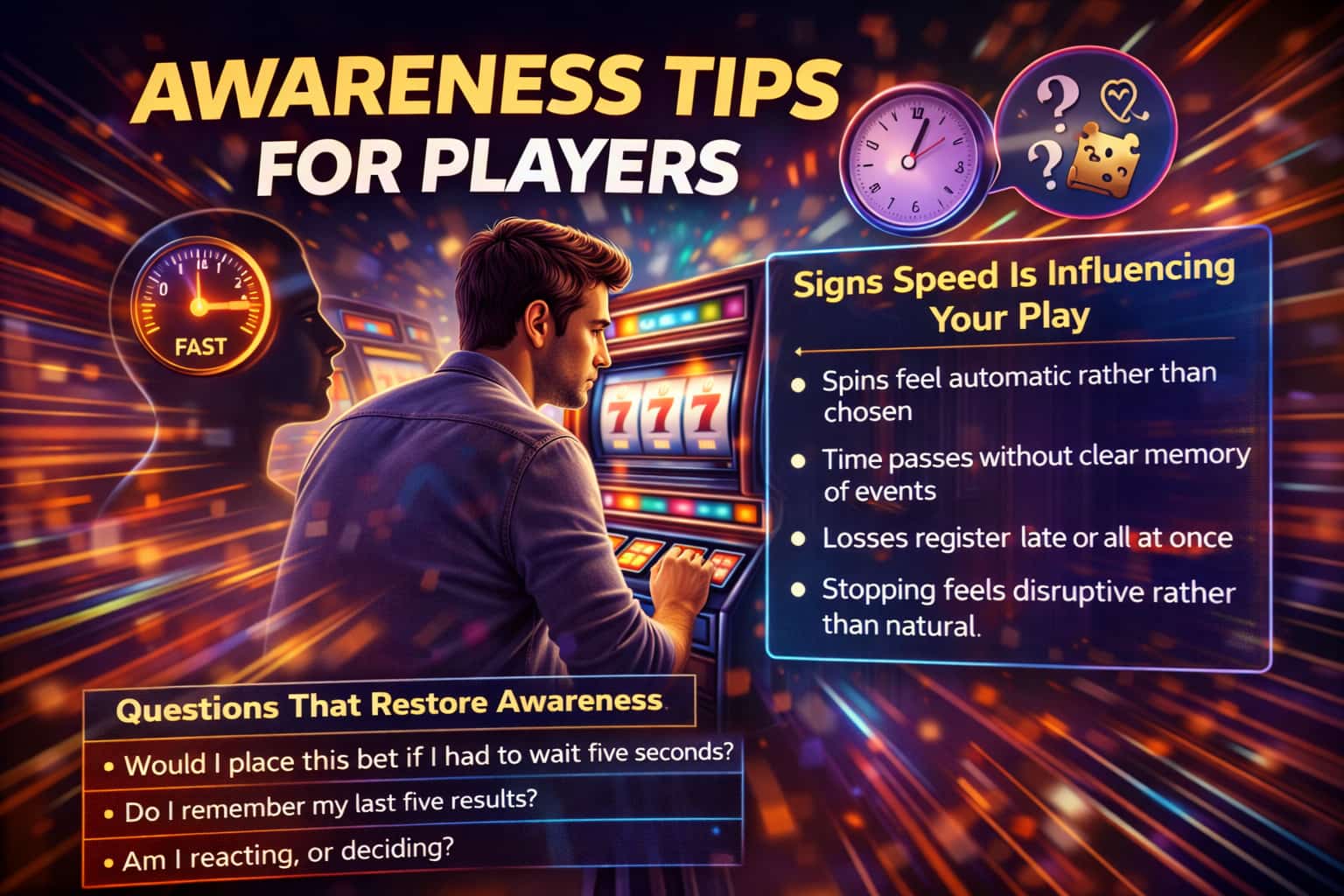
Speed influences behaviour most strongly when it goes unnoticed. The goal of awareness isn’t to control outcomes, but to recognise when pace is shaping decisions instead of intention.
These cues help players identify when speed is driving behaviour.
Signs Speed Is Influencing Your Play
You may be playing faster than you realise if:
- Spins feel automatic rather than chosen
- Time passes without clear memory of events
- Losses register late or all at once
- Stopping feels disruptive rather than natural
These are behavioural signals, not moral failings.
Questions That Restore Awareness
Simple internal prompts can reintroduce reflection:
- “Would I place this bet if I had to wait five seconds?”
- “Do I remember my last five results?”
- “Am I reacting, or deciding?”
If the answer feels unclear, pace may be too high.
Speed vs Intention Check
| Experience | Likely Driver |
| Smooth, effortless continuation | Momentum |
| Clear awareness of wins/losses | Intention |
| Difficulty stopping | Speed |
| Easy pausing or ending | Control |
This isn’t about right or wrong — it’s about clarity.
Awareness Doesn’t Mean Slowing Everything Down
Some players enjoy fast play. Awareness simply means:
- Knowing when speed increases exposure
- Recognising when judgement feels blurred
- Understanding why sessions feel different at different paces
Speed itself isn’t the issue — unnoticed speed is.
Reframing the Role of Speed
Instead of asking:
“Is this game risky?”
It’s often more useful to ask:
“How fast is this game asking me to decide?”
This question cuts through odds, features, and surface-level design.
Final Takeaway
Speed doesn’t change probability — it changes perception, emotion, and behaviour. By recognising how pace influences decisions, players gain clarity without sacrificing enjoyment. Awareness doesn’t slow play down. It puts the player back in control of how they engage with it. Speaking of speed, one area where being super fast is popular with players is with instant withdrawal casinos – so make sure any site you play it has nice and fast withdrawals and doesn’t waste your time.
Frequently Asked Questions
Does faster play change the odds of gambling games?
No. Faster play does not change the odds, RTP, or house edge of a game. The mathematics remain the same regardless of speed. What changes is how players make decisions and how much exposure they have over a given period of time.
Why do fast pokies feel more intense than slow ones?
Fast games compress decisions and outcomes into short timeframes. This reduces reflection, increases emotional overlap, and creates a sense of momentum, making play feel more immersive and intense.
Is autoplay riskier than manual play?
Autoplay doesn’t change the odds, but it reduces deliberation and removes natural pauses. This can lead to longer sessions, higher turnover, and reduced awareness of cumulative losses.
How does speed affect decision fatigue?
Faster play increases the number of decisions made in a short period. Over time, this leads to decision fatigue, where judgement weakens and players rely more on habit and momentum.
Why does fast play make it harder to stop?
Fast play creates behavioural momentum. With fewer pauses between outcomes, stopping feels disruptive rather than natural, making continuation the default behaviour.
Can slowing down improve outcomes?
Slowing down doesn’t improve odds or reduce house edge. However, it improves awareness and emotional regulation, helping players make more intentional decisions about continuing or stopping.
Does speed matter more than stake size?
Both matter, but in different ways. Stake size affects financial impact per bet, while speed affects how often bets are placed. Faster speed increases exposure to variance even at small stakes.
How can players tell when speed is influencing their behaviour?
Signs include automatic spinning, loss of time awareness, delayed emotional response to losses, and difficulty recalling recent outcomes. These signals suggest pace is driving behaviour rather than conscious choice.