

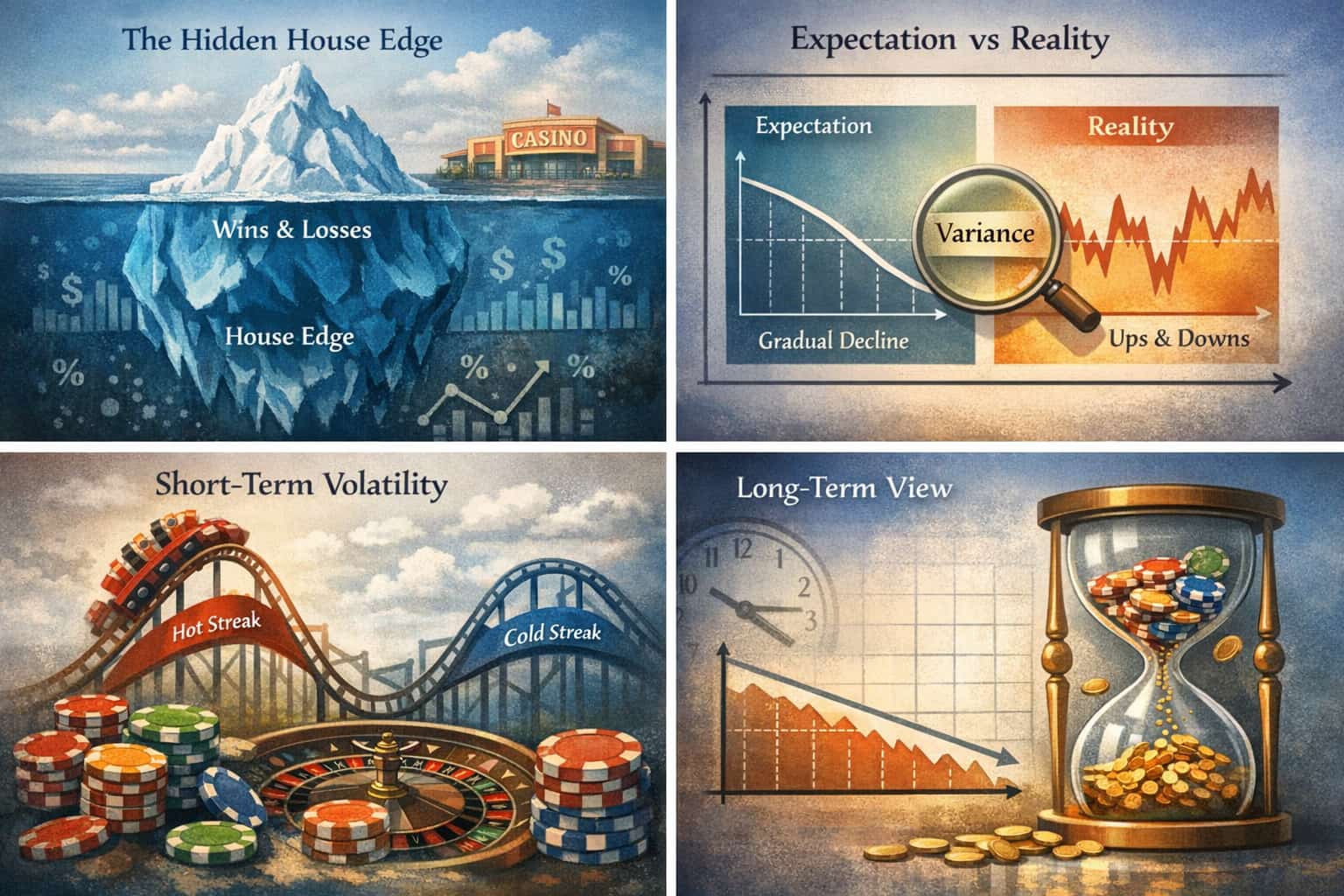
Most players understand, at least in theory, that casino games are designed with a house edge. They know the casino is expected to win over time. Yet when people actually play, that edge is almost impossible to feel, identify, or point to in real time.
There’s no visible deduction, no steady drain, and no clear signal that says, “this is the house edge at work.” Instead, players experience wins, losses, streaks, and swings — outcomes that feel driven by luck rather than mathematics.
This disconnect is not accidental. House edge is not designed to be felt per spin or even per session. It operates quietly, spread across thousands or millions of outcomes, expressed through probability rather than immediate loss. In the short term, randomness dominates experience. In the long term, expectation quietly asserts itself.
As a result, many players misinterpret what house edge actually does. They expect it to show up as a gradual decline, a visible “leak” in their balance, or a consistent disadvantage they can observe moment by moment. When that doesn’t happen, they conclude that the edge is small, inconsistent, or sometimes absent altogether.
This article explains why that perception exists.
We’ll look at:
- How house edge operates silently in the background
- Why losses don’t feel smooth or gradual
- How variance masks expectation in short sessions
- Why volatility dominates lived experience
- Why players consistently misjudge the size and impact of the edge
Understanding why house edge is invisible during play doesn’t make gambling less engaging. It makes outcomes easier to interpret — and prevents randomness from being mistaken for fairness, luck, or “beating the system.”
How House Edge Works Silently
House edge is often misunderstood as something that acts per bet or per spin, as if the casino takes a small cut every time you play. In reality, it doesn’t work that way at all.
House edge is a statistical expectation, not a visible mechanism.
What House Edge Actually Is
House edge represents the average amount a player is expected to lose over a very large number of bets, expressed as a percentage of total stakes.
| Game Example | House Edge | What It Means in Practice |
| Pokie | 4% | £4 expected loss per £100 wagered (long term) |
| Roulette (European) | 2.7% | £2.70 expected loss per £100 wagered |
| Blackjack (optimal play) | ~0.5% | £0.50 expected loss per £100 wagered |
Crucially, this expectation is spread across countless outcomes — not deducted steadily.
Why You Don’t “See” the Edge
During actual play:
- Wins can exceed losses for long periods
- Losses can arrive in clusters
- Balances can rise despite negative expectation
These outcomes are all normal. The house edge isn’t absent — it’s simply submerged beneath randomness.
Edge vs Outcome
| Concept | What It Describes |
| House edge | Long-term average expectation |
| Outcome | Individual result or session |
| Variance | Short-term deviation from expectation |
Players experience outcomes and variance, not expectation.
Why the Edge Feels Passive
House edge doesn’t:
- Force losses
- Guarantee losing sessions
- Appear as a constant drain
Instead, it slightly biases probabilities so that, over time, losses outweigh wins.
The Silent Nature of Expectation
Expectation works quietly:
- Small disadvantages compound slowly
- Short sessions are dominated by luck
- Long-term trends emerge invisibly
This is why the edge feels theoretical during play — because in the moment, it is.
Key Takeaway
House edge isn’t something you can feel, track, or observe spin by spin. It operates silently in the background as a statistical tendency, revealed only across large numbers of bets — not in real-time play.
Why Losses Don’t Feel Gradual
If house edge worked the way many players expect, losses would feel slow and steady — a small amount disappearing with each bet. Instead, losses tend to arrive in bursts, separated by wins and long periods of balance movement in either direction.
This uneven experience is one of the main reasons house edge feels invisible.
Expectation vs Lived Experience
| What Players Expect | What Actually Happens |
| Small, steady losses | Irregular wins and losses |
| Predictable decline | Streaks and swings |
| Clear disadvantage | Ambiguous outcomes |
House edge does not express itself smoothly. It expresses itself statistically.
Why Losses Cluster
Casino games are driven by randomness, not averaging. Random systems naturally produce:
- Losing streaks
- Winning streaks
- Long runs without balance change
These clusters feel meaningful, but they are expected behaviour in random sequences.
Why Gradual Loss Is a Myth
Players often imagine that negative expectation should look like:
“I lose a little bit each time.”
But in reality:
- Some bets win
- Some lose
- Most resolve independently
The edge slightly tilts the odds, but doesn’t control when losses occur.
The Role of Wins in Hiding Loss
Wins interrupt loss perception:
- They reset emotional memory
- They suggest recovery
- They obscure long-term trend
A few wins can erase the feeling of dozens of small losses.
Why This Feels Fair in the Moment
Because losses aren’t continuous:
- Play feels “balanced”
- Results feel mixed
- The edge feels weak or absent
This is exactly how negative expectation remains tolerable — and invisible — during play.
Key Takeaway
Losses don’t feel gradual because house edge doesn’t drain balances evenly. Randomness delivers outcomes in uneven clusters, masking the slow influence of expectation and making the edge difficult to perceive in real time.
Variance Masking Explained
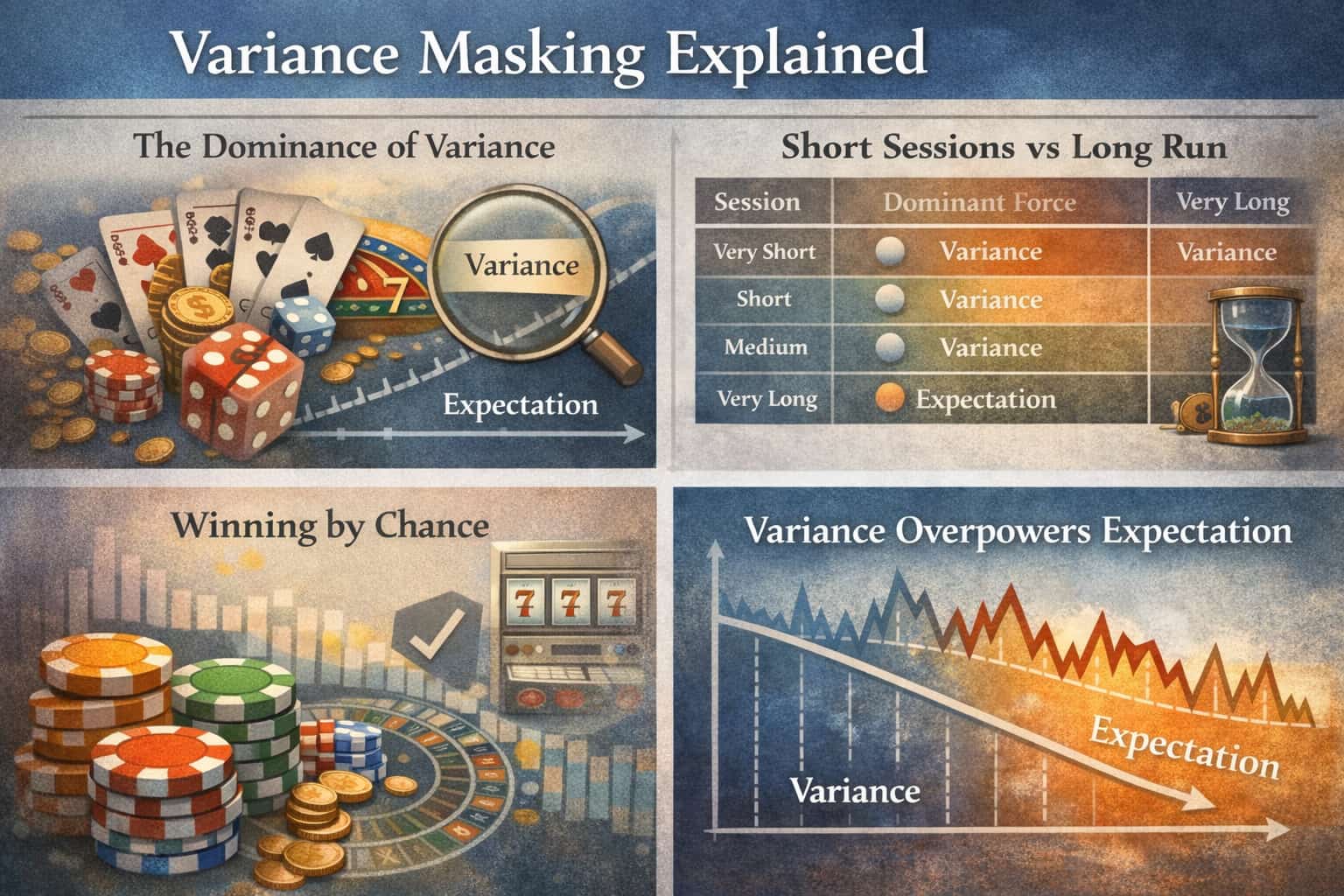
Variance is the reason house edge stays hidden during play. It’s the natural fluctuation that causes results to swing above and below expectation, often for long stretches. In short sessions, variance doesn’t just influence results — it dominates them.
Because players experience variance first and expectation second (if at all), house edge is effectively masked.
What Variance Actually Is
Variance describes how much individual outcomes can differ from the long-term average.
- High variance: large swings, big wins and losses
- Low variance: smaller swings, steadier results
Both can exist alongside the same house edge.
How Variance Masks the Edge
| Session Length | Dominant Force | What Players Feel |
| Very short | Variance | Luck, streaks |
| Short | Variance | Hot/cold games |
| Medium | Mixed | Inconsistent results |
| Very long | Expectation | Gradual decline |
Most players operate almost entirely in the variance-dominated zone.
Why Winning Doesn’t Disprove the Edge
Because variance allows:
- Long winning streaks
- Profitable short sessions
- Apparent “beating” of games
These outcomes feel like evidence that the edge is weak or avoidable. In reality, they are expected deviations, not contradictions.
Why Losing Feels Random, Not Systematic
When losses occur:
- They don’t follow a pattern
- They don’t appear proportional
- They don’t feel “designed”
This randomness makes it hard to attribute losses to house edge, even though it’s influencing probabilities in the background.
Variance vs Fairness Confusion
Players often equate:
- Volatility with unfairness
- Smooth play with fairness
But variance is neutral. It doesn’t favour players or casinos — it simply obscures expectation in the short term.
Key Takeaway
Variance masks house edge by overwhelming short-term experience with randomness. Because most play happens in short sessions, players feel swings and streaks — not the quiet influence of expectation operating underneath.
Short-Term Volatility Effects
Short-term volatility is what players actually experience when they play. It’s the immediate sequence of wins and losses that shapes emotion, memory, and judgement. Because house edge operates over the long term, short-term volatility effectively drowns it out.
This is why players talk about games being “hot” or “cold” rather than favourable or unfavourable.
Why Volatility Feels Like the Whole Story
In short sessions:
- Outcomes swing sharply
- Streaks stand out
- Balance changes feel decisive
These effects command attention, while expectation remains abstract and unseen.
Volatility vs Expectation in Practice
| Time Horizon | What Dominates | What Players Notice |
| A few spins | Volatility | Immediate results |
| One session | Volatility | Streaks, swings |
| Many sessions | Mixed | Inconsistency |
| Very long run | Expectation | Gradual loss |
Because most players stop well before the long run, volatility defines reality.
Why Big Wins Hide the Edge
A single large win can:
- Reverse a losing session
- Create the sense of profit
- Reinforce belief in fairness
Even when expectation is negative, volatility can deliver outcomes that feel overwhelmingly positive.
Why Losing Sessions Don’t Reveal the Edge Either
Losing sessions usually feel:
- Unlucky
- Random
- Temporary
Players attribute losses to bad runs rather than to structural disadvantage, because volatility makes losses look accidental rather than inevitable.
Memory Bias and Volatility
Short-term volatility shapes memory:
- Big wins are remembered
- Slow losses are forgotten
- Sessions feel defined by peaks
This selective recall further obscures the role of house edge.
Key Takeaway
Short-term volatility dominates player experience. It produces wins, losses, and streaks that feel meaningful and self-contained, preventing the slow influence of house edge from being recognised during normal play.
Long-Term Expectation vs Reality
House edge is usually explained in long-term terms: over thousands or millions of bets, online casinos expect to win a certain percentage of all money wagered. This explanation is mathematically accurate — but it rarely matches how gambling is actually experienced.
For most players, the “long term” never arrives.
What Long-Term Expectation Assumes
Long-term expectation relies on conditions that rarely apply in real play:
- Extremely large numbers of bets
- Consistent stake sizes
- No emotional decision-making
- No stopping after big wins or losses
These assumptions are necessary for mathematical averages to become visible.
How Real Play Differs
| Mathematical Model | Real Player Behaviour |
| Millions of bets | Dozens or hundreds |
| Fixed stake | Variable stake |
| Continuous play | Stop-start sessions |
| No emotion | Emotion-driven decisions |
Because reality diverges so sharply from the model, expectation remains abstract.
Why Players Rarely Experience the “Average”
Even players who gamble frequently tend to:
- Stop after significant wins
- Stop after heavy losses
- Change games or stakes
- Reset sessions mentally
These interruptions prevent results from ever converging toward expectation.
The Illusion of Neutral Outcomes
Because balances move up and down:
- Players feel “even” over time
- Losses feel offset by wins
- The edge feels delayed or avoidable
In reality, the expected loss accumulates quietly across many sessions — just not in a way that feels continuous.
Why Reality Feels Inconsistent
From a player’s perspective:
- Some sessions are winning
- Some are losing
- Patterns feel unstable
From a mathematical perspective:
- All sessions are part of the same expectation curve
The disconnect between these perspectives makes house edge feel theoretical rather than real.
Key Takeaway
Long-term expectation is real, but rarely experienced. Because players operate in short, interrupted sessions with changing behaviour, the house edge doesn’t present itself as a steady trend — it stays hidden behind lived variability.
Why Players Misjudge the Edge
Even when players understand that a house edge exists, they consistently misjudge its size, impact, and relevance. This isn’t because the maths is especially complex — it’s because human perception isn’t built to intuitively understand probabilistic disadvantage.
Several cognitive biases work together to distort how the edge is interpreted.
Common Misjudgements About House Edge
Players often believe:
- “The edge only matters if I play a lot”
- “I can feel when the edge is active”
- “Good sessions cancel out bad ones”
- “Some games don’t really have an edge”
These beliefs feel reasonable, but they don’t reflect how expectation works.
Cognitive Biases at Work
| Bias | Effect on Perception |
| Availability bias | Big wins dominate memory |
| Recency bias | Latest outcomes feel most important |
| Confirmation bias | Evidence supporting fairness is favoured |
| Outcome bias | Judging systems by short-term results |
Together, these biases cause players to overweight experience and underweight probability.
Why Fairness Feels Like Balance
Because wins and losses alternate:
- Play feels balanced
- The edge feels weak
- Losses feel temporary
Randomness creates enough positive outcomes to sustain the belief that results are fair or neutral.
Misinterpreting Variance as Control
When players win:
- They credit timing or decisions
- They assume skill or insight
When they lose:
- They blame bad luck
- They expect reversal
In both cases, the role of house edge remains invisible.
Why Percentages Are Hard to Feel
A 2–5% disadvantage:
- Feels negligible per bet
- Is invisible over short sessions
- Accumulates quietly over time
Because humans perceive discrete events better than averages, the edge never feels concrete.
Key Takeaway
Players misjudge house edge because short-term experience overwhelms abstract probability. Cognitive biases make wins feel meaningful and losses feel temporary, preventing the slow influence of expectation from being recognised during play.
Mathematical Invisibility
House edge is invisible during play because it is not an observable event. It’s a statistical property, not a mechanic that manifests at any specific moment. There is no individual spin, hand, or round where the house edge “shows itself.”
This is one of the most important — and least intuitive — aspects of casino maths.
Why You Can’t See the Edge in Action
Players often expect the house edge to appear as:
- A consistent loss rate
- A visible deduction
- A detectable pattern
None of these happen, because the edge does not operate at the level of individual outcomes.
Edge vs Outcome vs Expectation
| Concept | What It Represents | Can You Observe It Directly? |
| Outcome | A single result | Yes |
| Variance | Short-term deviation | Yes |
| House edge | Long-term expectation | No |
You can observe results and swings. You cannot observe expectation unfolding in real time.
Why Individual Bets Are Misleading
On any single bet:
- The player might win more than expected
- Lose less than expected
- Or lose nothing at all
The house edge only exists in aggregate. Looking for it in individual outcomes is like looking for gravity in a single falling leaf.
Why “Tracking Results” Doesn’t Reveal the Edge
Even detailed tracking:
- Produces noisy data
- Shows large fluctuations
- Requires huge sample sizes
Short-term tracking highlights variance, not expectation. This leads players to conclude the edge is inconsistent or avoidable.
The Sample Size Problem
To meaningfully observe house edge:
- You need thousands or millions of bets
- With consistent conditions
- And no behavioural changes
This is far beyond normal play patterns.
Why the Edge Feels Theoretical
Because it can’t be pointed to or isolated, house edge:
- Feels abstract
- Feels optional
- Feels delayed
But mathematical invisibility doesn’t mean absence — it means scale matters.
Key Takeaway
House edge is invisible because it isn’t an event you can witness. It’s a statistical tendency that only becomes measurable across massive numbers of bets. During normal play, variance dominates perception, making the edge effectively unobservable.
What House Edge Actually Means
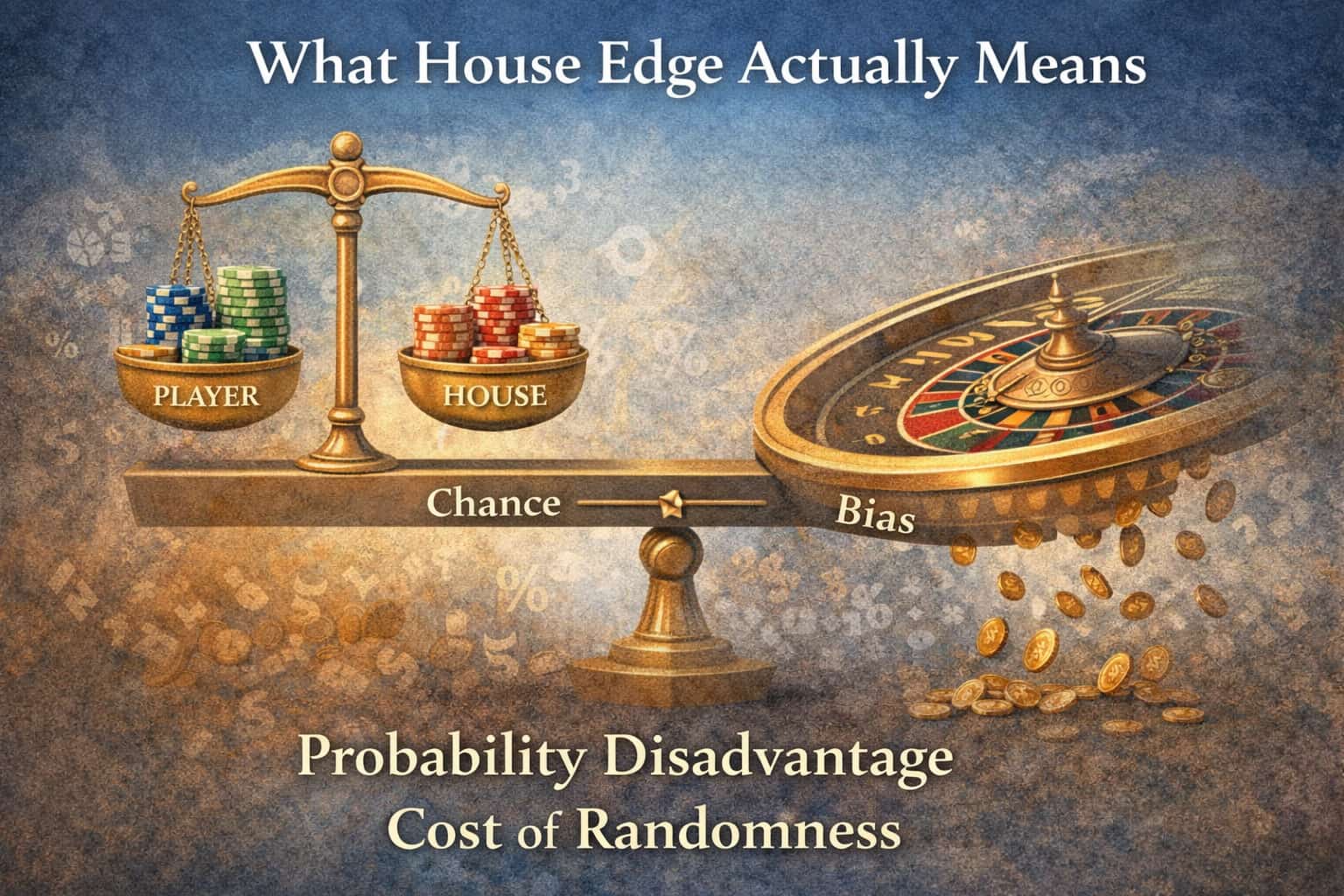
House edge is often described as a “hidden tax” or an invisible drain on player funds. While that language is intuitive, it can also be misleading. House edge isn’t something taken from you directly — it’s a probabilistic imbalance built into the structure of the game.
Understanding this distinction helps explain why the edge feels invisible during play.
House Edge Is Not a Fee
House edge does not mean:
- The casino takes a fixed cut per bet
- Losses are scheduled or enforced
- Wins are artificially limited
Instead, it means the probabilities are slightly tilted so that losses outweigh wins over time.
A Better Way to Think About It
| Misconception | More Accurate View |
| “The house takes money” | The game favours the house |
| “I’m paying to play” | I’m facing a probability disadvantage |
| “Losses are caused by edge” | Losses emerge from randomness with bias |
The edge shapes likelihood, not outcomes.
Why the Edge Feels Fair
Because:
- Wins occur regularly
- Big wins are possible
- Outcomes vary widely
The experience feels fair, even when expectation is negative. Fairness in gambling is about transparency and randomness, not equal odds.
Edge and Player Choice
House edge doesn’t remove agency:
- Players choose when to play
- How much to stake
- When to stop
These choices affect experience, but not the underlying expectation.
Reframing House Edge Correctly
House edge is best understood as:
- The cost of randomness
- The price of uncertainty
- The reason games resolve unpredictably but consistently favour the casino
It’s not something to “beat” in the short term — it’s something to account for in understanding outcomes.
Key Takeaway
House edge isn’t invisible because it’s hidden — it’s invisible because it’s statistical. It exists as a long-term probability imbalance, not a moment-by-moment force. During play, randomness dominates. Over time, expectation quietly asserts itself.
Frequently Asked Questions
What does house edge actually mean?
House edge is the long-term statistical advantage built into a casino game. It represents the average amount a player is expected to lose over a very large number of bets, not a fee taken from each spin or hand.
Why can’t players feel the house edge while playing?
Because house edge operates over the long term. During short sessions, randomness and volatility dominate results, producing wins, losses, and streaks that mask the underlying probability disadvantage.
Does house edge apply to every single bet?
No. House edge does not apply on a per-bet basis in a visible way. Individual bets can win, lose, or break even regardless of the edge. The disadvantage only becomes measurable when outcomes are aggregated over many bets.
Why don’t losses feel gradual if the edge is always there?
Losses don’t arrive evenly because outcomes are random. Random systems naturally produce clusters of wins and losses, which makes results feel irregular rather than steadily declining.
Can short winning sessions disprove the house edge?
No. Winning sessions are expected outcomes in random systems. Variance allows players to win in the short term even when the long-term expectation is negative.
Is house edge the same as RTP?
They are related but expressed differently. RTP (Return to Player) represents the percentage returned to players over time, while house edge is the remaining percentage retained by the casino. A 96% RTP corresponds to a 4% house edge.
Why do players often underestimate the impact of house edge?
Players tend to focus on recent outcomes, memorable wins, and short-term results. Cognitive biases cause experience to outweigh abstract probability, leading to systematic underestimation of long-term disadvantage.
Can tracking results reveal the house edge?
Not reliably. Short- and medium-term tracking mostly reflects variance, not expectation. Observing house edge accurately would require extremely large sample sizes under consistent conditions.
Does house edge mean games are unfair?
No. House edge reflects a probability imbalance, not deception. Fairness in casino games is defined by transparent rules and genuinely random outcomes, not equal chances of winning.